

A Syllabus for Teaching Identity in a Divided World
Free materials for teaching social identity, cooperation, conflict, AI, misinformation, and leadership.

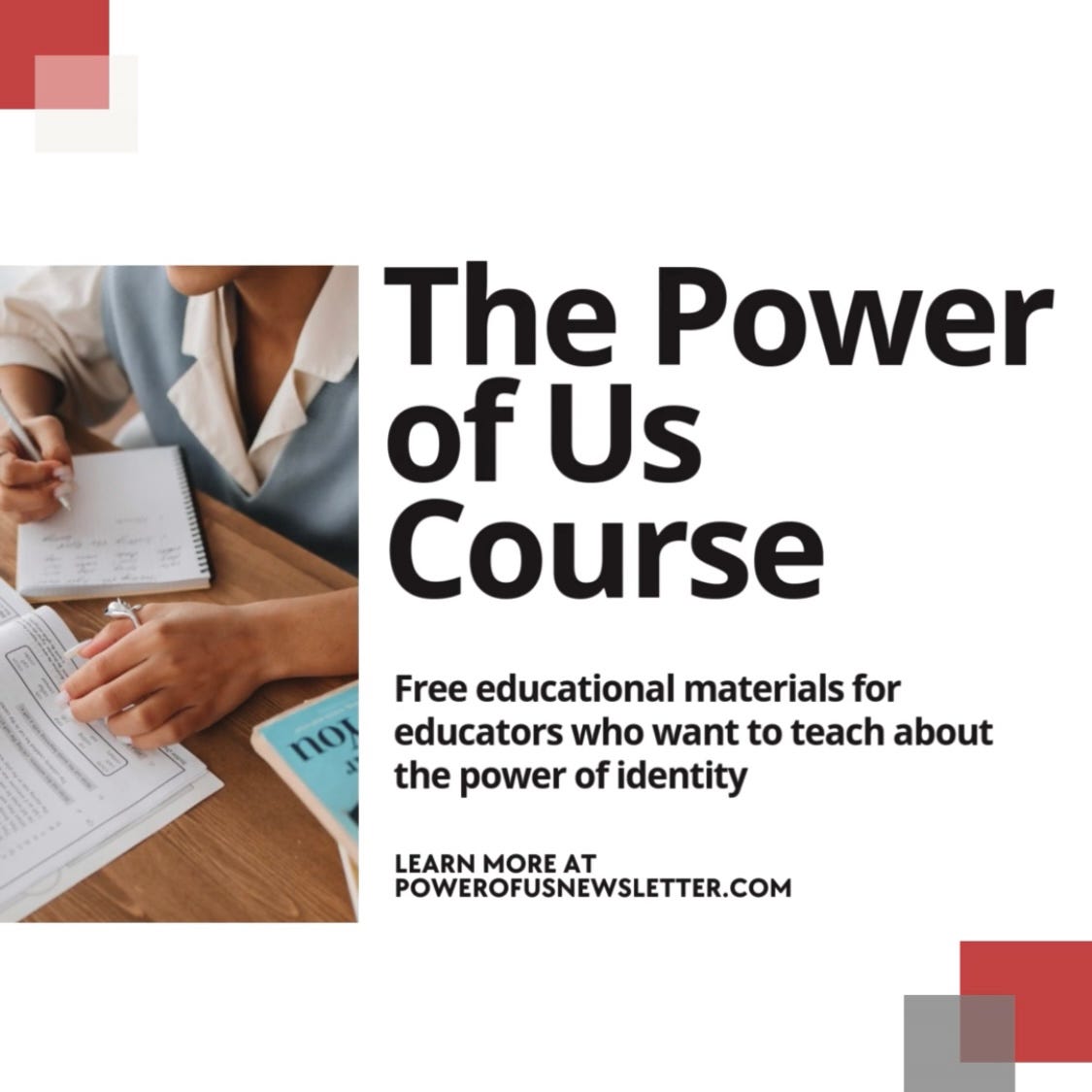
Teaching people about social identity, group dynamics, and intergroup relations is more important than ever. Students are living through an era of intense polarization, online conflict, generational divides, and eroding trust in institutions. So we updated our free Power of Us syllabus and teaching materials to help instructors teach the science of identity with fresh examples, new readings, classroom activities, videos, and editable slides.
Students already understand that identity matters. They see it in politics, online discourse, campus debates, fandom culture, workplace dynamics, and AI-mediated information. This course gives them a scientific framework for understanding why identity can divide people—and how it can also promote cooperation, solidarity, and social change.
We created a free syllabus and supplementary teaching materials for anyone interested in teaching about social identity. This is a chance for people to learn directly from our book, and go beyond to dig into the original research, new studies, and educational videos and podcasts we created. We curated the most relevant articles for each chapter and added new research published since we wrote the book.
Our free educational content package includes:
Syllabus and course schedule
Educational videos
Suggested readings (including debunking famous psychology studies)
Chapter summaries & key takeaways
Lecture slides (editable .pptx file)
Test questions
Interactive activities/assignments
Interactive class Q&A with either Jay or Dom
Newsletters discussing related topics (eg., new content on AI)
Visit this link to request our teaching materials and keep scrolling down for the .word and .pdf links to the syllabus!
The course syllabus is ideal for college students, but can easily be adapted for high school classes and book clubs (e.g., by focusing on on the book and excluding any assignments), organizations (e.g., by removing the academic journal articles and replacing them case studies or practical activities), or advanced academic seminars (e.g., by focusing on the original research articles and requiring an original research project). Be creative and adapt the content for their audience—then let us know so we can share it with others.
How instructors can use these materials
Full seminar: Teach the entire book across 10 weeks.
Introduction to psychology module: Use one or two weeks on social identity, group behavior, and cooperation.
Social psychology course: Pair chapters with classic and contemporary papers.
Leadership / organizational behavior: Use chapters on cooperation, dissent, and effective leadership.
Political psychology / media course: Use modules and readings on echo chambers, misinformation, social media, and AI.
We visit the classes of educators who use our teaching materials! In the past few years, we visited several classes at universities around the world. We also did an interactive Q&A with Dr. Helen Harton’s course Influence: Harnessing Psychology to Create a Better World and created a newsletter with our Q&A with students from her class. We did the same thing recently for a large book club at the Social & Affective Neuroscience Institute in Brazil.
To facilitate deeper engagement we now have a mailbox where students can send us questions and we will share the answers in a newsletter roughly once a month. We also created a “Power of Us Chatbot” for subscribers. It is trained on our book and newsletter to answer any questions you have about our content from our book, research, and newsletter, and applying it to your own questions (password: _subscriber). Finally, we have monthly “office hours” for premium subscribers.
We will also offer a free premium subscription to the Power of Us newsletter for any educator who assigns our book in their class. This will keep you up to date with new research, book reviews, and educational materials you can use in the future. It will also allow you to join our office hours to discuss any relevant issues.
Our book and teaching material has been used at numerous universities around the world, including Yale University, New York University, University of Southern California, University of St. Andrews, University of Amsterdam, Vanderbilt University, Monash University, University of Porto, University of Northern Iowa, University of Tennessee, Tecnologico de Monterrey, University of the Western Cape, SUNY Buffalo, ISG Business & Economics School of Lisbon, Chapman University, Saint Joseph’s University, Rochester Institute of Technology, Hendrix College, Western CT State University, Soka University of America, Trent University, Carleton University, Northeast Lakeview College, University of North Carolina, and Stevens Institute of Technology among others. Let us know if we missed your school and we will add it to the list.
Course Title: The Power of Shared Identity
Course Description: This course provides an overview of the psychology of shared social identities and their surprising influence on human thoughts, feelings, and behaviors. Students will learn frameworks for understanding identity and group dynamics from the book The Power of Us. Videos and case studies can be used to analyze effective and problematic uses of identity in achieving cooperation, reducing bias, and fostering social change. Students will apply course principles through projects focused on harnessing the power of shared identities.
Required Text: “The power of us: harnessing our shared identities to improve performance, increase cooperation, and promote social harmony” by Jay Van Bavel & Dominic Packer. This can be purchased from our publisher or as an audio or kindle book from Amazon. Translations are also available in the UK, Canada, Brazil, Japan, China, Romania, Korea, Mongolia, and United Arab Emirates.
Course Objectives:
By the end of this course, students will be able to:
Explain theories on social identity, social categorization, and intergroup relations
Analyze how shared identities shape perceptions, beliefs, values, and behaviors
Assess the role of identity in contemporary issues like polarization, inequality, and climate change
Evaluate effective and problematic uses of identity in case studies
Design interventions to leverage shared identity for cooperation, performance, and overcoming bias
Course Schedule: The course is broken into 10 weeks of content (each week focuses on a different chapter from the book). However, the length can be adapted to add exams (e.g., adding two midterms and a final exam turns this into 13 week course) or assignments (e.g., we recommend adding a day at the end for class presentations).
Week 1: The Power of Us
Key topics: What is social identity and why is it powerful? Human needs for belonging, distinctiveness, and status.
Video: The sibling rivalry that divided a town (The TED-Ed Video includes exam items & further reading)
Activity: The WHO AM I? Challenge is a virtual tool we created to facilitate the 20 statements test we outline in our book. This will educate people about their own identities—especially hidden identities—and how these are connected to their social relationships. Students can visit the link here to do the class activity, and share their responses with us if they wish.
Newsletter: Why we are suckers for astrology, the Meyers-Briggs, and other pseudoscientific personality tests? + Debunking the five biggest myths in social psychology
Suggested readings
Tajfel, H. (1970). Experiments in intergroup discrimination. Scientific American, 223(5), 96-103.
Yang, X., & Dunham, Y. (2019). Minimal but meaningful: Probing the limits of randomly assigned social identities. Journal of Experimental Child Psychology, 185, 19-34.
De Cremer, D., & Van Vugt, M. (1999). Social identification effects in social dilemmas: A transformation of motives. European Journal of Social Psychology, 29(7), 871-893.
Cohn, A., Fehr, E., & Maréchal, M. A. (2014). Business culture and dishonesty in the banking industry. Nature, 516(7529), 86-89.
Week 2: The Lens of Social Identity
Key topics: Identities shape perceptions, tastes, and attention. Identities can also misdirect and bias.
Newsletter: What it means to contain multitudes
Suggested readings
Xiao, Y. J., Coppin, G., & Van Bavel, J. J. (2016). Perceiving the world through group-colored glasses: A perceptual model of intergroup relations. Psychological Inquiry, 27(4), 255-274.
Pandey, K., Stevenson, C., Shankar, S., Hopkins, N. P., & Reicher, S. D. (2014). Cold comfort at the Magh Mela: Social identity processes and physical hardship. British Journal of Social Psychology, 53(4), 675-690.
Kahan, D. M., Hoffman, D. A., Braman, D., Evans, D., & Rachlinski, J. J. (2012). " They Saw a Protest": Cognitive Illiberalism and the Speech-Conduct Distinction. Stanford Law Review, 851-906.
Williams, T., et al., (April 1, 2016). Police body cameras: What do you see? New York Times. https://www.nytimes.com/interactive/2016/04/01/us/police-bodycam-video.html
Week 3: Sharing Reality
Key topics: Groups influence beliefs through norms and social dynamics. Avoiding groupthink and gravitating toward truth.
Video: Why do people cling to false beliefs? (Youtube)
Newsletter: Fighting misinformation with science
Suggested readings
Augenblick, N., Cunha, J. M., Dal Bó, E., & Rao, J. M. (2016). The economics of faith: Using an apocalyptic prophecy to elicit religious beliefs in the field. Journal of Public Economics, 141, 38-49.
Tourish, D., & Vatcha, N. (2005). Charismatic leadership and corporate cultism at Enron: The elimination of dissent, the promotion of conformity and organizational collapse. Leadership, 1, 455-480.
Van Bavel, J. J. & Pereira, A. (2018). The partisan brain: An identity-based model of political belief. Trends in Cognitive Sciences, 22, 213-224.
Robertson, C. E., Pretus, C., Rathje, S., Harris, E., & Van Bavel, J. J. (2022). How social identity shapes conspiratorial belief. Current Opinion in Psychology, 101423.
Week 4: Escaping Echo Chambers
Key topics: Rising polarization and the role of identities. Solutions for bridging identity-based divides.
Video: Do politics make us irrational? (The TED-Ed Video comes with exam items + further reading)
Newsletter: Is polarization really a problem? + Can AI help us escape our echo chambers?
Suggested readings
Finkel, E. J., Bail, C. A., Cikara, M., Ditto, P. H., Iyengar, S., Klar, S., ... & Druckman, J. N. (2020). Political sectarianism in America. Science, 370(6516), 533-536.
Crockett, M. J. (2017). Moral outrage in the digital age. Nature Human Behaviour, 1(11), 769-771.
Bail, C. A., Argyle, L. P., Brown, T. W., Bumpus, J. P., Chen, H., Hunzaker, M. F., ... & Volfovsky, A. (2018). Exposure to opposing views on social media can increase political polarization. Proceedings of the National Academy of Sciences, 115(37), 9216-9221.
Rathje, S., Van Bavel, J. J., & van der Linden, S. (2021). Out-group animosity drives engagement on social media. Proceedings of the National Academy of Sciences, 118, e2024292118
Week 5: The Value of Identity
Key topics: What drives identification? Why people identify with underdogs and value identity symbols.
Newsletter: Using social norms to clean up your community
Suggested readings
Akerlof, G. A., & Kranton, R. E. (2000). Economics and identity. The Quarterly Journal of Economics, 115(3), 715-753.
Cialdini, R. B., Borden, R. J., Thorne, A., Walker, M. R., Freeman, S., & Sloan, L. R. (1976). Basking in reflected glory: Three (football) field studies. Journal of Personality and Social Psychology, 34(3), 366.
Griskevicius, V., Tybur, J. M., & Van den Bergh, B. (2010). Going green to be seen: status, reputation, and conspicuous conservation. Journal of Personality and Social Psychology, 98(3), 392.
Hornsey, M. J., & Jetten, J. (2004). The individual within the group: Balancing the need to belong with the need to be different. Personality and Social Psychology Review, 8(3), 248-264.
Week 6: Overcoming Intergroup Bias
Key topics: The nature and roots of bias across identities. How understanding identities can reduce bias.
Video: How to reduce discrimination between groups (YouTube)
Newsletter: Reducing racial bias in the sharing economy
Suggested readings
Acharya, A., Blackwell, M., & Sen, M. (2016). The political legacy of American slavery. The Journal of Politics, 78, 621-641.
Van Bavel, J. J., Packer, D. J., & Cunningham, W. A. (2008). The neural substrates of in-group bias: A functional magnetic resonance imaging investigation. Psychological Science, 19, 1131-1139.
Mousa, S. (2020). Building social cohesion between Christians and Muslims through soccer in post-ISIS Iraq. Science, 369, 866-870.
Murrar, S., Campbell, M. R., & Brauer, M. (2020). Exposure to peers’ pro-diversity attitudes increases inclusion and reduces the achievement gap. Nature Human Behaviour, 4, 889-897.
Week 7: Finding Solidarity
Key topics: Shared adversity creates identities and prosocial behavior. Marginalized group solidarity for social change.
Video: What leads people to help others? (YouTube)
Newsletter: Debunking the bystander effect
Suggested readings
Levine, M., Prosser, A., Evans, D., & Reicher, S. (2005). Identity and emergency intervention: How social group membership and inclusiveness of group boundaries shape helping behavior. Personality and Social Psychology Bulletin, 31, 443-453.
Drury, J., Cocking, C., & Reicher, S. (2009). The nature of collective resilience: Survivor reactions to the 2005 London bombings. International Journal of Mass Emergencies and Disasters, 27, 66-95.
Becker, J. C., & Wright, S. C. (2011). Yet another dark side of chivalry: Benevolent sexism undermines and hostile sexism motivates collective action for social change. Journal of Personality and Social Psychology, 101, 62.
Feinberg, M., Willer, R., & Kovacheff, C. (2020). The activist’s dilemma: Extreme protest actions reduce popular support for social movements. Journal of Personality and Social Psychology, 119, 1086.
Week 8: Fostering Dissent
Key topics: Why insiders dissent and how groups can encourage it.
Newsletter: Debunking the myth that conformity is irrational
Suggested readings
Reicher, Stephen D., S. Alexander Haslam, and Joanne R. Smith. "Working toward the experimenter: Reconceptualizing obedience within the Milgram paradigm as identification-based followership." Perspectives on Psychological Science 7.4 (2012): 315-324.
De Dreu, C. K., & West, M. A. (2001). Minority dissent and team innovation: the importance of participation in decision making. Journal of Applied Psychology, 86(6), 1191.
Packer, D. J. (2008). On being both with us and against us: A normative conflict model of dissent in social groups. Personality and Social Psychology Review, 12(1), 50-72.
Edmondson, A. C. (2003). Speaking up in the operating room: How team leaders promote learning in interdisciplinary action teams. Journal of Management Studies, 40(6), 1419-1452.
Week 9: Identity Leadership
Key topics: Effective leaders are “entrepreneurs of identity”. Inspiring through identity vs misusing identity.
Video: How can leaders communicate more effectively?
Newsletter: Debunking the Stanford Prison Experiment + Four things successful teams do differently
Suggested readings
Wang, X. H. F., & Howell, J. M. (2010). Exploring the dual-level effects of transformational leadership on followers. Journal of Applied Psychology, 95(6), 1134.
Steffens, N. K., Haslam, S. A., & Reicher, S. D. (2014). Up close and personal: Evidence that shared social identity is a basis for the ‘special’ relationship that binds followers to leaders. The Leadership Quarterly, 25(2), 296-313.
Haslam, S. A., Reicher, S. D., & Van Bavel, J. J. (2019). Rethinking the nature of cruelty: The role of identity leadership in the Stanford Prison Experiment. American Psychologist, 74(7), 809-822.
Haslam, S. A., Reicher, S. D., Selvanathan, H. P., Gaffney, A. M., Steffens, N. K., Packer, D., ... & Platow, M. J. (2022). Examining the role of Donald Trump and his supporters in the 2021 assault on the US Capitol: A dual-agency model of identity leadership and engaged followership. The Leadership Quarterly, 101622.
Week 10: The Future of Identity
Key topics: Facing future challenges: identities and inequality, climate change, democratic backsliding.
Documentary: Protecting Democracy in a Time of Extreme Polarization
Newsletter: How to talk about climate change and the problem with doomerism
Suggested readings
Mols, F., & Jetten, J. (2016). Explaining the appeal of populist right-wing parties in times of economic prosperity. Political Psychology, 37, 275-292.
Yaden, D. B., Iwry, J., Slack, K. J., Eichstaedt, J. C., Zhao, Y., Vaillant, G. E., & Newberg, A. B. (2016). The overview effect: Awe and self-transcendent experience in space flight. Psychology of Consciousness: Theory, Research, and Practice, 3.
Waldner, D., & Lust, E. (2018). Unwelcome change: Coming to terms with democratic backsliding. Annual Review of Political Science, 21, 93-113.
Berkebile-Weinberg, M., Goldwert, D., Doell, K. C., Van Bavel, J. J., & Vlasceanu, M. (2024). The differential impact of climate interventions along the political divide in 60 countries. Nature Communications, 15, 3885.
Voelkel, J. G. et al. (2024). Megastudy identifying effective interventions to strengthen Americans’ democratic attitudes. Science, 386, 6719.
Please visit these links if you prefer to view and download the syllabus as a .pdf or a word doc. In addition to numerous translations, we also have audio and kindle versions.Our book website includes several reviews if you want to see what other people thought about the book before you assign it.
Finally, we find it useful to offer links to career advice for students in our classes. So we created a single newsletter summarizing all the career advice columns Jay wrote for Science Careers as part of his Letters to Young Scientists column. Feel free to share it with your students.
If you teach a course where this might fit, please use it. If you know someone who teaches psychology, leadership, political science, communication, education, or conflict resolution, please forward this to them. And if you use the materials in class, leave a comment—we’d love to hear what worked and what we should add next year.
News and Updates
Use our Mailbox to send us your questions
We also now have a mailbox where you can send us your questions and we will share the answers in a newsletter once a month
Talk to the “Power of Us Chatbot”
We created a “Power of Us Chatbot” for subscribers. It is trained on our book and newsletter to answer any questions you have about our content and applying it to your own questions. The chatbot was created by Androw Ramy and Rémi Thériault in the Center for Conflict & Cooperation.f Let us know if you like it or have any suggestions. You’ll need to use the password: _subscriber
Join us for “Ask Me Anything” sessions for summer! Premium subscribers can join us for our monthly live Q&A with Jay or Dom where you can ask us anything from workshopping research questions, career advice to opinions and recommendations on pop culture happenings. Upgrade your subscription using the button below.
Invites to RSVP have been sent via email from powerofusbook@gmail.com
June 4 @ 4:00pm EST with DomJuly 6th @ 1:00pm EST with Jay
August TBA @ EST with Dom
September 10th @ 3:00pm EST with Jay

Observation:
A syllabus is more than a reading list.
It is a map of what its authors believe deserves sustained attention.
Observation:
The material emphasizes identity as a framework for understanding diverse social phenomena.
Conclusion:
That makes identity a powerful explanatory lens.
Whether it is the most sufficient lens remains an empirical question.
Strong frameworks organize evidence.
The strongest ones also remain open to evidence they cannot yet explain.