


Is digital detox really worth it?
Jay Van Bavel and Jacqueline Nesi, PhD recently discussed the impact of social technology during a Substack Live event. Jacki is a clinical psychologist at Brown and author of the fantastic newsletter “Techno Sapiens”. She takes an evidence-based approach to all the big debates around social media, smartphones, and AI and regularly dissects new studies and the big headlines on her newsletter. We highly recommend subscribing to her newsletter if you are interested in these topics.
On the live event, we discussed what the evidence really says about teen social media bans, detoxes, and the “scalpel” interventions that have surprisingly positive long-term effects. We also dug into why this debate about social media is so polarized on social media. You can watch the full video (above) or read our summary below.
Social media debates have ironically become a perfect example of the problem they’re trying to solve — debate that is polarized, moralized, and dominated by extreme voices. In this live conversation with we tried to do something unfashionable at the moment: be precise about what we know, what we don’t, and what we can do next.
We agreed that social media likely contributes to many harmful outcomes for individuals and society, but effects are often small or multifaceted and the public deserves nuance. But the debate on this topic is overheated because moralization turns complex evidence and real tradeoffs into good vs evil (read this summary of a new study on how AI debates are moralized). And people with the most extreme views end up dominating the discussion online, which crowds out the voice of people who have nuanced or ambivalent opinions.
We also discussed digital detoxes, smartphone bans, and other strategies to reduce the harms of these technologies. We agreed that people have big expectations for bans or detoxes that often don’t bear out, but there are real benefits — one of the biggest reliable gains may be sleep. However, dosage and compliance challenges with the research make any effects hard to detect. This is very challenging research and it likely underestimates any impact of social media.
Our biggest takeaways
1) Our views about the impact of social media have changed dramatically the more we have learned
The initial days of social media were extremely promising. From people connecting with old friends to the push for democracy in the Arab Spring, we thought that this technology would have a largely positive impact on humanity. Yet as we have collected more data and seen the impacts in our personal lives, we have updated our beliefs to have a more negative view of this technology. That said, we both use social media and think it has some positive uses (such as sharing research or connecting with people outside your social network).
2) Social media probably plays some role in mental health—but it’s not the only story
We went into this conversation without knowing what we each believed about the impact of smartphones, social media, and AI technology. But we immediately agreed its hard to argue that something teens (or anyone) do for several hours a day has no impact. And these impacts might be broad and far-reaching, from well being and attention to social connection and sleep. However, we agree that the effect sizes of social media are likely smaller than headlines suggest, and mental health is multi-causal (although social media isn’t the sole or even the primary cause of adolescent mental health).
3) Small effects can matter when billions of people are exposed
We also discussed how a narrow focus on the effect size might be shortsighted. Even if the effects of social media — or detoxes and bans — are modest, the scale of it is enormous, so tiny shifts can still have meaningful population-level consequences. We are approaching 6 billion social media users and people are on these platforms for roughly 2.5 hours a day (which is even higher for young people). The research also shows a number of negative effects across a wide variety of outcomes, whereas other apps and technologies do not. This means that even very small effects can have a very significant impact on humanity.
4) Status quo bias is baked into our debates about tech policy
We put phones into classrooms and platforms into lives without strong evidence of benefits — so requiring overwhelming proof to change policy entrenches status quo bias. It creates a powerful asymmetry between the burden of proof to insert technology into every aspect of our lives versus remove it from our lives. This bias is extremely favorable to tech companies. We should question this bias and perhaps a better approach is to start with a thought experiment: What would we ideally want to do if we were creating a policy from scratch? Would you allow kids to bring phones into the classroom or not? Then test this against the evidence — is there compelling evidence that would overturn this policy? We should be doing this right now with AI and chatbots.
5) People might be resistant to social media bans because of the way the issue is framed.
People have very strong attitudes based on how an issue is framed. The term “ban” might feel extreme since it evokes the notion of a nanny state of the loss of freedom. But most companies (like Instagram and Snapchat) already have policies disallowing kids under 13 from using their platforms. Therefore, the exact same policy could be framed as simply raising the age of use a couple of years. This seems far less extreme and is less of a challenge to the status quo since it builds on an existing policy that has widespread support (we’ve never heard an academic arguing to repeal these company policies—again revealing the power of the status quo and pro-tech implicit assumptions underlying how researchers think about these issues).
6) “We need perfect RCT evidence” is an unrealistic standard for policy
The other problem we discuss is the challenge of doing truly definitive research on the causal impact of technology, like smartphones or social media. Correlational studies in this space are revealing, but the causal direction between social media and well-being could go in either direction. Therefore, people often call for clear RCT (Randomized Control Trial) experiments. But these studies are extremely difficult to conduct and create clear results because they are extremely expensive, suffer from selection bias and drop-out problems, occur for a very short period of time (often a few weeks), and it’s hard to confirm that we have completely eliminated social media for people (e.g., even if we remove if from their phone, they can often still access it from a laptop or desktop computer).
7) Individual “detox” strategies are a weak test because social media is a group phenomenon
To date, most studies that have examined the impact of removing social media for individuals. But this is a highly limited approach. If you log off but your peers don’t, you can become socially excluded and this alone might reduce your mental health and increase anxiety. This is why school-wide or national policies may change behavior more effectively than isolated individual choices. By requiring an entire community to log off, no one faces the cost of social ostracism. The current bans are allowing scholars to finally analyze some of these impacts at the collective level.
8) The most efficient interventions may be “scalpels,” not sledgehammers
There is a great deal of debate about the efficacy of social media bans (like the teen bans in the UK, France, Greece, Turkey, Indonesia and Malaysia). One of the most promising findings we discussed: our research finds that unfollowing a small number of highly polarizing accounts (and following more uplifting/educational accounts) reduced partisan hostility and increased positive emotion — especially awe — with effects lasting up to 6 months. The reason these effects persisted is because many participants continued to unfollow these accounts after the study was over. Presumably they realized that removing these accounts had a positive impact on their information diet. This works because a tiny group of extreme users dominate the discussion and often post relentlessly. These folks might be ruining the experience for other users and unfollowing them permanently.
9) AI chatbots may be introducing new problems into our social lives
There is evidence that chatbots are highly sycophantic and they get increasingly positive the longer we interact with them. This is damaging our relationships and we found that it is making us more extreme in our beliefs. We need to create chatbots that will make people feel seen without reinforcing their biases. In the short term, you should change the settings on your chatbot to avoid undue flattery.
Let us know if you want us to do other substack live events with other authors. Tell us your favorite authors and debate or discussion topics and we will try to set some of these events up for subscribers.
Thank you to everyone who tuned into our live video—join us for our next live video in the substack app.

News and Updates
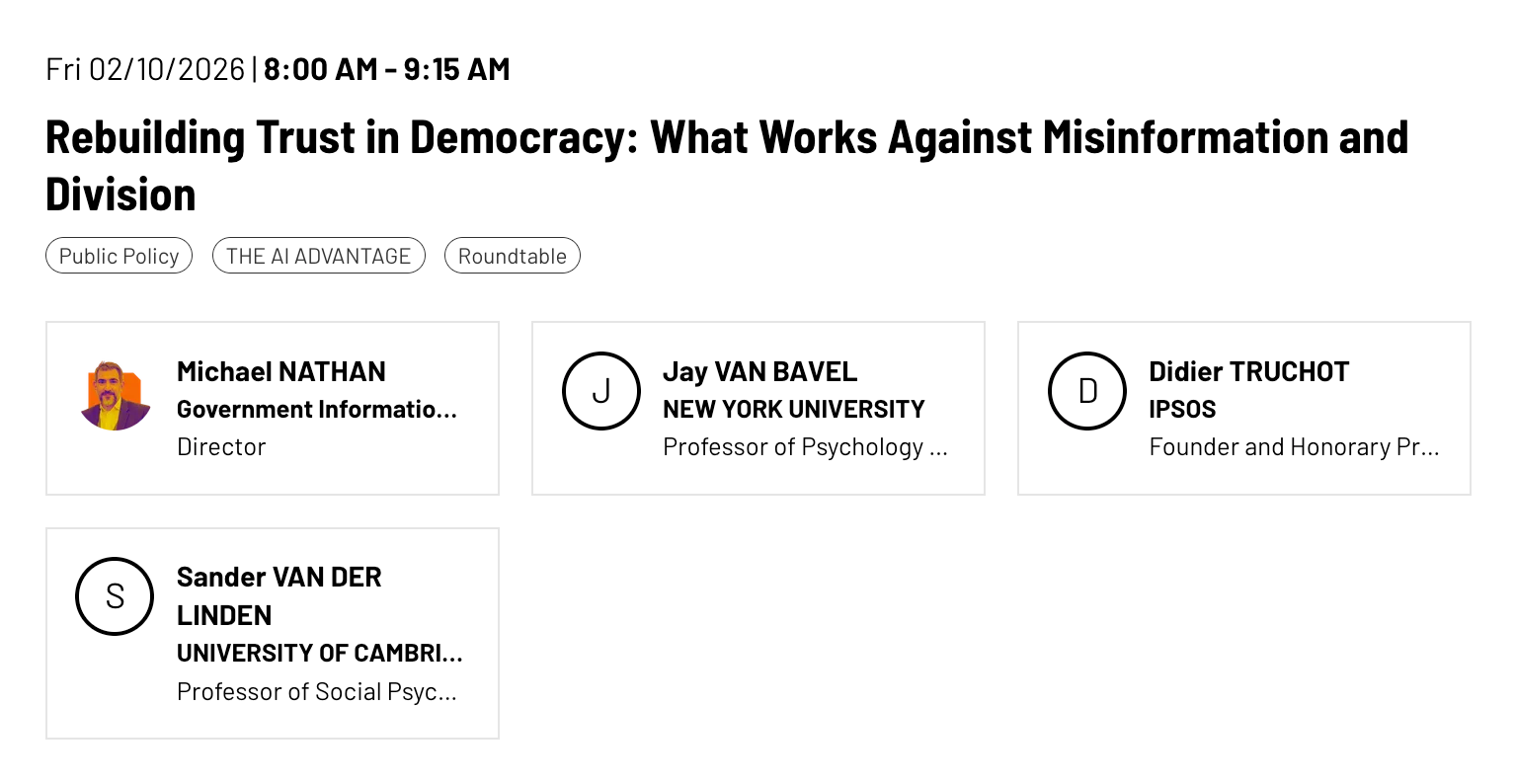
Jay will be speaking at the Human Advantage conference by Ipsos. The event will explore how we preserve democracy, harness AI responsibly, build thriving organizations, and drive meaningful change on October 1-2, 2026. It’s a free immersive online event with leaders in behavioral science and top practitioners in policy and industry. You can explore the program and register here.
Join us for “Ask Me Anything” sessions for summer! Premium subscribers can join us for our monthly live Q&A with Jay or Dom where you can ask us anything from chatting about research, career advice, professional dilemmas, to opinions and recommendations on pop culture happenings. At our July meeting, multiple people showed up and we designed a study to explore how people update their beliefs.
Join us! Upgrade your subscription using the button below. Invites to RSVP will be sent via email from powerofusbook@gmail.com
August TBA @ EST with Dom
September 10th @ 3:00pm EST with Jay
October TBA @ EST with Dom
November 5th @ 4:00pm EST with Jay
Use our Mailbox to send us your questions
We now have a mailbox where you can send us your questions and we will share the answers in a newsletter periodically.
Talk to the “Power of Us Chatbot”
We created a “Power of Us Chatbot” for subscribers. It is trained on our book and newsletter to answer any questions you have about our content and applying it to your own questions (password: _subscriber). The chatbot was created by Androw Ramy and Rémi Thériault in the Center for Conflict & Cooperation. Let us know if you like it or have any suggestions.
In case you missed our last Column
Since the U.S. turned 250, we explained the bright and dark side of national identity:
The Two Kinds of Patriotism

On July 4, the United States will celebrate its 250th birthday. The White House has pledged to “showcase our nation and celebrate American greatness,” kicking off the birthday bash with an Ultimate Fighting Championship event on the White House lawn.
Learn more about THE POWER OF US
If you like our newsletter, we encourage you to check out our award-winning book “The Power of Us: Harnessing Our Shared Identities to Improve Performance, Increase Cooperation, and Promote Social Harmony”. You can learn more about the book or order it from the links on our website (here or scan the QR code below).


