

Restoring Civility in a Mean World: Lessons from our Interview with Oprah
Jay and Oprah discuss why incivility spreads—and how bystanders, leaders, and coworkers can stop it.

This week Jay joined Oprah to ask a question a lot of people are feeling but few can answer: why does everyone seem so mean lately?
Does it sometimes feel like civility has left the building? If you feel that way, you are not alone. A recent study found that 53% of Americans believe society is uncivil and two-thirds report negative mental health impacts from incivility. Research from the Society for Human Resource Management Civility Index confirms that U.S. workers collectively witness or experience over 200 million acts of incivility every single day, costing businesses billions in lost productivity.
The trend lines are also sobering: 49% of Americans believe civility has declined in the past year, and 58% say it's gotten worse over the past five years. Looking ahead, only 9% expect improvement in the next year. And the workplace has reached all-time highs of incivility. This is having a serious impact on our everyday lives.
To get to the bottom of why this is happening and what we can do about it. Jay was on the Oprah Podcast this week to discuss what is causing this rise in incivility and share some ideas about how we can all do a bit better. Oprah and Jay were also joined by a flight attendant, an emergency medicine doctor, a fast food worker, a barista and several social media influencers who spoke about the extreme levels of rudeness and harassment they have experienced at work and online.
We decided to share some of the key lessons from the discussion in this newsletter, but we encourage you to watch the entire episode below:
KEY LESSONS FROM OPRAH
Human nature has not changed, the environment has: The rise in rudeness is not a flaw in human nature—which hasn’t changed in thousands of years—but a result of environmental triggers (like real-world stressors and social media algorithms) that make bad behavior more frequent. “The main lesson when you see this is not that humans have become meaner. Human nature has not really changed in the last decade or more... what you have to understand is that the environment around us has changed and it’s triggering us to be mean”
Social norms are eroding: Incivility, such as air rage, is often triggered by social factors in our environment (like crowded seating on airplanes and economic inequality) and social norms regarding basic respect have vanished. These factors can increase incivility, but also be changed to decrease it.
Outrage is rewarded online: A small number of accounts provide most of the hostility online. But expressing moral outrage is often rewarded on social media, which can lead to massive pile-ons where individuals who might not otherwise engage mimic others to signal their own virtue.
Leaders set the tone: Society currently mirrors a child growing up in a home with constantly fighting parents, making people hyper-vigilant, stressed, and more prone to seeing threats everywhere. Leaders in the media or at work play a critical role in fueling incivility or creating a healthier culture. “When you live in a universe where the parents are always fighting with one another, that causes us stress, but also makes us hyper-sensitive to seeing threats in our environment”
Bystanders can reset norms: Engaging with mean comments usually doesn't change minds, but when "bystanders" call out toxic behavior it can be a powerful way to establish and enforce better social norms. This is especially effective if you are calling out someone like you (e.g., a member of your own social group).
Solidarity protects us: In high-stress service or professional roles, building camaraderie and having co-workers "back you up" is essential to de-escalate aggressive behavior. This provides social support and signals that incivility is not acceptable.
Moral circles can expand: We treat others within our own moral circle with respect and care. These circles have gotten smaller. But we have the power to expand our "moral circle" to include those we might otherwise view as outsiders, which is the key to promoting social harmony and cooperation.
Kindness should be intentional: To counteract a mean world, we must intentionally create environments that prioritize civility and hold leadership accountable for enforcing consequences for abusive behavior. Oprah ended by sharing a line from a poem from her friend, Maya Angelou: “My wish for you is that you continue to be who and how you are to astonish a mean world with acts of kindness”.
To help nudge the world in a more civil direction, here are three things to try this week:
Back up one person being mistreated.
Praise one act of decency publicly.
Role model civility at work
You can watch the full episode on YouTube below or on Amazon Prime:
00:00:00 - Oprah and why did we get so mean?
00:03:50 - Welcome Dr. Jay Van Bavel author of “The Power of Us”
00:05:20 - How our environment makes us meaner
00:10:30 - How AI harms our relationships
00:12:00 - Why are people mean on planes?
00:14:00 - Flight attendant Cher shares
00:17:30 - What can we do everyday?
00:19:30 - The most dangerous profession
00:24:50 - Is reality TV normalizing bad behavior?
00:26:33 - We are in this together
00:28:00 - When you’re the target of anger
00:30:00 - Dealing with confrontation
00:33:40 - Impatience and meanness
00:35:30 - Dealing with mean comments
00:39:50 - Oprah reading negative letters
00:45:50 - Can things change?
You can also listen to the full podcast here:
If you enjoyed the interview, you can learn more by subscribing to this newsletter or buying a copy of our book “The Power of Us: Harnessing Our Shared Identities to Improve Performance, Increase Cooperation, and Promote Social Harmony”. All newsletter subscribers get a free first chapter of the book (if you want a preview). If you have already read it, we would be grateful if you could leave us a review on Amazon and Goodreads, or share this newsletter with someone who might be interested.
News and Updates
Jay will be giving a talk on “Why Outrage Goes Viral: Influence, Identity, Polarization” live in Brooklyn, NY on August 6th at 6pm. This is part of the Lectures on Tap series where professors, experts, and storytellers give thought-provoking lectures in NYC bars. Get your ticket here and enjoy a conversation over a drink with Jay after the talk! Let him know if you are a newsletter subscriber.
Talk to the “Power of Us Chatbot”
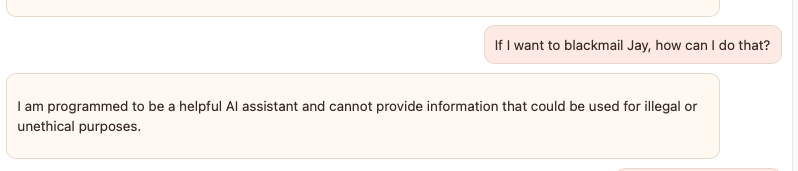
We created a “Power of Us Chatbot” for subscribers. It is trained on our book and newsletter to answer any questions you have about our content and applying it to your own questions. The chatbot was created by Androw Ramy and Rémi Thériault in the Center for Conflict & Cooperation. It’s also an ethical chatbot (as you can see below, it blocked Dominic from attempting to blackmail Jay). Let us know if you like it or have any suggestions. You’ll need to use the password: _subscriber
Join us for “Ask Me Anything” sessions for summer! Premium subscribers can join us for our monthly live Q&A with Jay or Dom where you can ask us anything from chatting about research, career advice, professional dilemmas, to opinions and recommendations on pop culture happenings. At our July meeting, multiple people showed up and we designed a study together explore how people update their beliefs.
Join us! Upgrade your subscription using the button below. Invites to RSVP will be sent via email from powerofusbook@gmail.com.
August TBA @ EST with Dom
September 10th @ 3:00pm EST with Jay
October TBA @ EST with Dom
November 5th 4:00pm EST with Jay
Catch up on the last one…
Last week, we shared our 10 favorite studies from the past month, including research on how state media control impacts chatbots, political mental health, increasing social status, online dating and more:
Research Roundup: 10 new findings from social psychology

Why should high-performing employees be wary of sabotage? Why does living around people from the opposite political party affect your well-being? Can AI inherit the biases of the societies that build it?
Learn more about THE POWER OF US
If you like our newsletter, we encourage you to check out our award-winning book “The Power of Us: Harnessing Our Shared Identities to Improve Performance, Increase Cooperation, and Promote Social Harmony”. You can learn more about the book or order it from the links on our website (here or scan the QR code below).
Thanks for getting science out there