

How to Disagree Better
People need to engage more with opposing viewpoints (book interview + giveaway with Julia Minson)

Disagreement is inescapable. Yet people often avoid disagreements because engaging can feel unproductive or even a bit terrifying when they don’t have the right tools. Intergroup conflict, polarization, conflicts in the workplace, and relationships can be difficult to navigate because both (or all) parties often believe they are right.
In a new book, How to Disagree Better, Harvard University public policy professor, Dr. Julia Minson, argues that most of us have been approaching disagreement the wrong way. You can present your case with bulletproof logic. You can share compelling data. You can explain exactly why you’re right. And somehow, the other person digs in even deeper.
She argues that the best frameworks for disagreement that are grounded in scientific evidence are the ones that focus on language. The H.E.A.R. strategy acknowledges the counterpart while making your own point. It’s also important that people increase their use of positive language (rather than words like “don’t”, “never” and “no”) and emphasize agreement. These strategies create a bridge and a sense of empathy and respect.
Any time that you disagree with someone, there’s a 50% chance that you are wrong. More, if you consider the times when both people are wrong. — Julia Minson
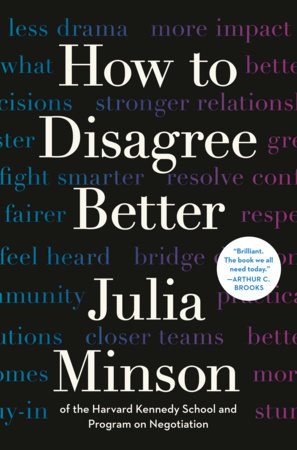
Click here to learn more about How to Disagree Better and order a copy now! Plus, we are giving away 5 free physical copies to The Power of Us subscribers. To enter the giveaway, check out the details at the bottom of this newsletter.
What does your book teach us about social identity or group dynamics?
My book offers evidence-based approaches for effectively navigating disagreement. People’s beliefs are often correlated with their group identities, with group members sharing particular attitudes and convictions, and making unfounded assumptions about the attitudes and convictions of out-group members. To the extent that we can learn to have thoughtful, engaged, authentic conversations with people whose opinions we don’t share, we can start becoming more comfortable crossing group boundaries and making interesting connections with “the other side.”
What is the most important idea readers will learn from your book?
There are a lot of books out there on navigating conflict and disagreement, but very few of them are based on rigorous empirical science. As a result, we do some things right, but also waste time on ineffective approaches. I want people to know that there is a growing experimental science of conflict and if they follow the research they will save themselves time and drama.
Perhaps the most important thing I have learned from doing research in this area is that our mental efforts in disagreement do very little to improve outcomes. Well intentioned attempts to take our counterparts’ perspective, be more patient, be better listeners, feel more empathy, etc. don’t help as much as we expect because people don’t have access to our internal mental states. In order for a strategy to improve the outcome of a conversation, your counterpart must notice it so they can react appropriately. Instead, we need to use externally visible, easily interpretable behaviors to telegraph our intention to disagree constructively. The most salient and consistently interpreted behavior in disagreement is language. So that’s where we should all be focusing our efforts.
What is one factoid, statistic or study in your book that everyone should know?
Expressing a willingness to learn about your counterpart’s perspective in a way that is transparent and recognizable, is one of the most powerful tools we have found for de-escalating conflict. Yet, people are truly abysmal at doing this in the course of a conversation.
When we put Democrats and Republicans into a chat room and asked them to discuss an upcoming election, the vast majority of them did not express any kind of interest in the opposing view. A handful of people asked questions, but the questions were often rhetorical or sarcastic, not ones than an opposing partisan would interpret as an expression of curiosity. In later studies, we found that getting people to verbally express a desire to learn is incredibly difficult — people seem to see the willingness to learn from opponents as a low status move and they don’t want to sound submissive in a competitive situation. Giving them specific words and phrases to say helps, and so do financial incentives. But a non-trivial proportion of people still won’t do it, and feels proud of it.
What will readers find provocative or controversial about your book?
A common belief in the popular conflict literature is that people are threatened by opposing views and for this reason avoid engaging with them or updating their beliefs. However, my research finds that threat has little to do with it.
People don’t want to engage with opposing views because they think they are right. They have respected sources, experiences, and evidence to support their beliefs. When somebody tries to offer a contradictory perspective, the reaction is not a feeling of threat, but usually a feeling of irritation, anger, or even disgust because we are quite certain in the fundamental correctness of our own beliefs and don’t like our time being wasted. This interpretation is in line with research on Naive Realism and suggests a different approach for navigating disagreement than an approach grounded in the idea that disagreeing others are all feeling threatened by our brilliance.
Do you have any practical advice for people who want to apply these ideas (e.g., three tips for the real world)?
Yes! In a lot of my writing and teaching, I have advocated for the use of “conversational receptiveness” - a communication style that allows us to express our views in disagreement in a way that persuades our counterpart that we are actively engaging with their perspective even as we are making our own point. The easiest way to get started on conversational receptiveness is by using the H.E.A.R. framework.
H = Hedge your claims, even when you feel very certain about your beliefs. It signals a recognition that there are some cases or some people who might support your opponent’s perspective.
E = Emphasize agreement. Find some common ground even when you disagree on a particular topic. This does not mean compromising or changing your mind, but rather recognizing that most people in the world can find some broad ideas or values to agree on.
A = Acknowledge the opposing perspective. Rather than jumping in to your own argument, devote a few seconds to restating the other person’s position to demonstrate that you did indeed hear and understand it.
R = Reframing to the positive. Avoid negative and contradictory words, such as “no,” “won’t” or “do not.” At the same time, increase your use of positive words to change the tone of the conversation.
News and Updates
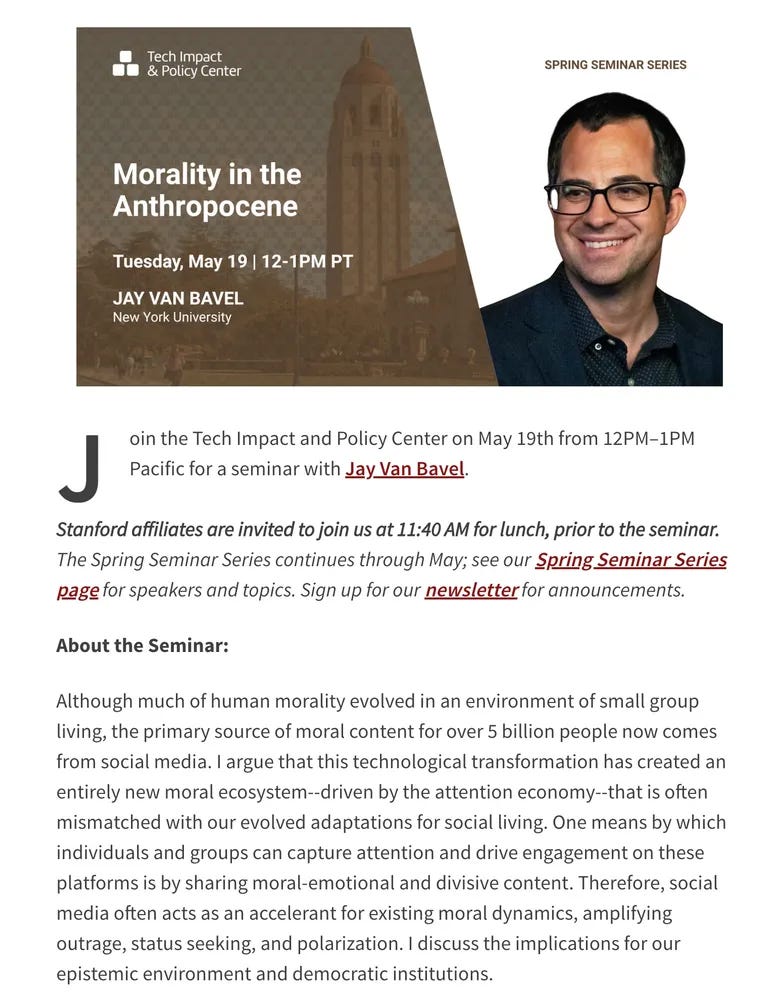
Jay is giving a talk at the Stanford Tech Impact & Policy Center on “Morality in the Anthropocene” on May 19th. You can attend in person or via zoom using this link.
🎁 Book Giveaway Details 📖
To enter Julia’s book giveaway for How to Disagree Better, either…
Be a paid subscriber to the newsletter. Paid subscribers are automatically entered into all our monthly book giveaways!
If you are not a paid subscriber yet, make sure you have a free subscription and simply leave a comment answering one the questions below:
Who is someone in your life (e.g., spouse, parent, child, team member) you disagree with often? Which component of H.E.A.R. can you focus on incorporating in your conversations with them?
Note: Giveaway is open to U.S. residents only. Enter before April 5th, 12 pm PST. Five winners will be selected at random and will recieve an email from powerofusbook@gmail.com on April 6th, 2026.
Catch up on the last one…
Entrepreneurs of Identity

In 1968, The Ohio State Buckeyes football team started one of the most cherished traditions in American sports. According to team legend, a member of the coaching staff proposed an idea to motivate the players. After each game, the coaches would reward the best players with small stickers resembling buckeye leaves to place on their helmets. The staff reasoned that rewarding stellar individual performances would provide the right incentive to excel. The Buckeyes won the national championship that year, and football teams around the country have copied the tradition of rewarding individual excellence.