


In 1968, The Ohio State Buckeyes football team started one of the most cherished traditions in American sports. According to team legend, a member of the coaching staff proposed an idea to motivate the players. After each game, the coaches would reward the best players with small stickers resembling buckeye leaves to place on their helmets. The staff reasoned that rewarding stellar individual performances would provide the right incentive to excel. The Buckeyes won the national championship that year, and football teams around the country have copied the tradition of rewarding individual excellence.
"Woody was always trying to get that extra motivational edge," proposed Rex Kern, OSU's quarterback in 1968.
By 2001, the once-dominant Buckeyes had slipped into mediocrity. When Jim Tressel was hired to coach the team, he completely revamped how players earned a buckeye. He turned an individual competition into an approach that rewarded teamwork.
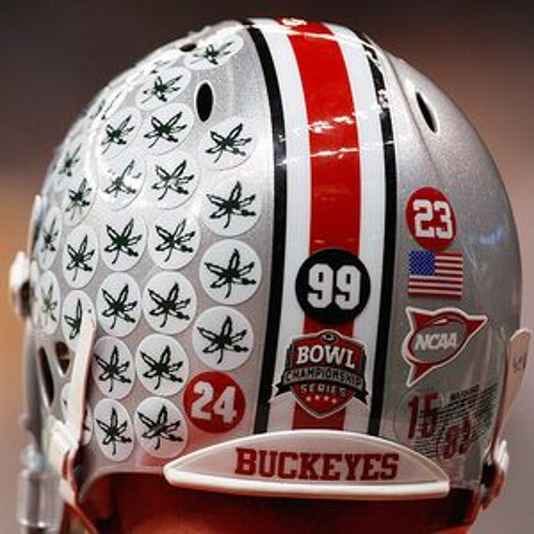
Instead of rewarding a player for scoring a touchdown, for instance, every player on the offensive unit would get a sticker if the team scored more than 24 points. And the coaching staff gave every player on the team a sticker after each win. Favoring teamwork over individual performance paid off almost immediately — the team not only won a national championship the following year, but the Buckeyes have been one of the most successful teams in the country ever since and are a threat to win the National Championship almost every year.
Although leaders are concerned with collective success, most organizations — from sports teams to universities to global companies — still focus on rewarding individual performance. General Electric CEO Jack Welch concocted the legendary “Rank and Yank” system to motivate employeers. The majority of Fortune 500 companies reward the most productive individuals, not the most effective groups or indispensable group members.
Rank and Yank guided talent assessments through a 3-step process:
Rank every employee’s job performance.
Use the rank-ordered list to identify a bottom segment of performers, usually 10%.
Fire those in the bottom segment.
Survivors then have their compensation calibrated according to where they fell on the rating curve. Or, as its also known, the Vitality Curve.
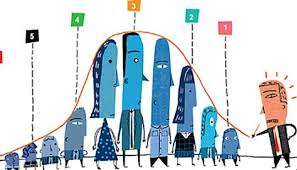
This Rank and Yank system uses fear and individual competition as motivators. While it creates a compliant workforce, there is little evidence of its success. If anything, it costs fortune in performance reviews and leads employees to "feel unmotivated and disengaged". We believe that leaders at these organizations are overlooking something fundamental about human nature — our groupish nature.
Human beings evolved in groups, and most of us still work in groups every day. Our affinity for groups is wired deeply into our basic biology. Indeed, humans are unique among primates in that we readily cooperate with in-group members — even if they are completely unknown to us. This is why sports fans can show up to a stadium and immediately share common purpose with 100,000 complete strangers.
Even more striking, research in our labs has found that the simple act of joining a group can produce a dramatic influence on brain function and behavior. At the mere flip of a coin, people readily befriend and place their trust in fellow in-group members. And our research has found that creating mixed-race groups can override implicit racial bias. Group identification is one ingredient that can bring strangers together.
Given that group membership is such a deeply rooted part of human nature and organizational success, a central element of leadership is the management of group identities. In short, great leaders are “Entrepreneurs of Identity”. They embrace our tribal nature and seek to shape the identity of their fellow group members. This social relationship between leaders and followers is at the heart of transformational leadership.
When a person starts to identify with a group, it triggers a fundamental shift in their goals. Events and decisions that were once evaluated with reference to oneself (“what’s in it for me?”) are now evaluated in reference to the group (“what does this mean for us?”). In fact, research shows that even otherwise selfish individuals often become cooperative — and even altruistic — when they identify with a group. Once their self becomes fused with the group, they are motivated to pursue what they understand to be the goals of the group.
Group identity can explain a range of remarkable behaviors, ranging from putting in long hours at work to making the ultimate sacrifice for one’s country. Many experiments have now shown that members will act to benefit to their groups, even when doing so exacts a personal cost. One reason is because we share in the success and rewards of our in-group members — we bask in their reflected glory and feel pleasure when they receive a reward. As such, the key to leading groups is fostering an environment in which individual group members deeply identify with the team.
To cultivate a strong group identity, leaders can take the following steps: (1) ensure the group satisfies basic the psychological needs of individual members, (2) generates super-ordinate goals, (3) rewards individual contributions to the group, and (4) values dissent.
Focus on employees’ social needs. Organizations traditionally use financial rewards to motivate employees, but great leaders also fulfill the social needs of their employees. Compelling groups satisfy one or more fundamental human needs, including the need to belong, obtain status, feel distinctive, and maintain certainty or control. By balancing individuals’ need to belong with their desire to stand out, a leader can build a sense of “optimal distinctiveness” among group members. Leaders seeking to increase members’ group identification need to first consider the basic social needs of their members and then determine how the group might do a better job fulfilling them.
Set superordinate goals. Recent neuroscience studies suggest that cooperation is inherently rewarding. But many people will only cooperate with fellow in-group members. In many organizations, the loyalty of employees lies with their department or project team, rather than the whole organization. While internal divisions can be useful at times — a bit of healthy competition between departments can drive people to work harder — employees can lose sight of organizational goals or may even sabotage other departments. Visionary leaders communicate the superordinate goals of the organization and explain how all the divisions, departments, and project teams are necessary for achieving these goals.
Reward both collective and individual effort. Leaders need to reward behavior that advances the goals of the organization, rather than the individual. Effective leaders provide bonuses, recognition, raises, flexibility, and opportunities, based on the entire team’s performance. To avoid free-riding (when team members shirk their personal responsibility), individual rewards should also be given to individuals who make important contributions to the team’s success. This rewards indispensable team members — the unsung heroes who work late, cover for colleagues, and enhance the success of the group. Combining individual and collective rewards can promote stronger group identity and ensure that individual members are encouraged and motivated (not only financial, but also socially) to pursue the team’s goals and help the team succeed.
Group cohesion can also be a weakness — suppressing dissent and creativity, and creating mindless conformity. How can leaders capitalize on the benefits of group cohesion while avoiding its drawbacks?
Avoid the downsides of conformity by valuing dissent. Many people assume that dissenters are trying to damage the group. But our research suggests that committed group members are the ones who are most likely to speak up when things are going badly for the group because they care deeply about group success. Thus, constructive dissent needs to be explicitly valued in organizations to avoid groupthink and bad decision-making. Leaders need to make it easy for group members to speak out against bad ideas. For instance, leaders can designate certain group members to act as devil’s advocate to ensure the group reaches the best possible decision. To create a culture where constructive feedback and innovation flourishes, leaders should also encourage their employees to pursue organizational goals rather than simply follow organizational norms.
The bottom line is that leaders need to understand and harness the tribal psychology that is deeply imprinted onto human nature. The ease with which people categorize the social world into groups speaks to our nature, and provides a powerful potential tool for leaders. Our capacity to identify with groups provides the foundations for cooperation with others — even complete strangers.
Notes of the week
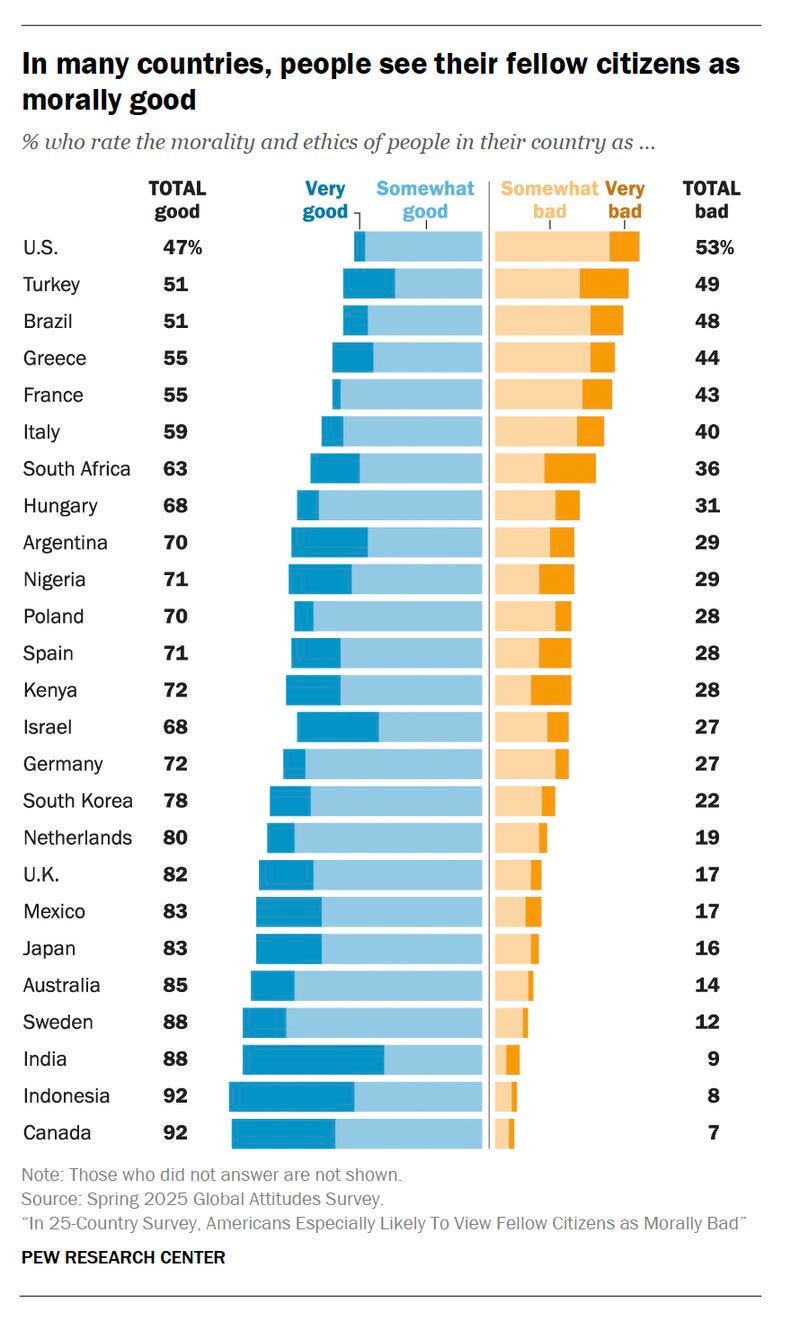
New public opinion survey 🗳️
The U.S. is the only country surveyed where more adults describe the morality of others living in the country as bad than good. Canada is on the opposite end of the spectrum: they overwhelmingly see their neighbors as morally good.
Polarization and social media
The more active people are on social media, the more polarized they are.
The opinions of the these extreme users are filling your newsfeed, but they are not representative of most citizens or even most social media users — who are far less polarized! This creates false perceptions of social norms and stereotypes, creating a funhouse mirror effect.
Catch up on the last one…
Last week, we shared a column from Dr. Mickey Inzlicht’s substack Speak Now Regret Later on stereotype threat and its replicability. We received notes from other scholars in the field and have linked a response from Mary Murphy of Culture Catalyst with Mary C. Murphy below from her expert perspective on the topic.


I'm autistic and I constantly have to "mask" to fit into any group outside my house. I have to pretend to be someone that's not me every day in any sort of working environment. Both of these things kill my energy and I don't have much left for anything else. I also have to pretend to like working in a group and pretend to like working with people I work with. Sometimes, I like one or two people, but not everyone. They all kill my energy because they're not just there to work, they're also there to socialize because that's what neurotypicals like to do.
I wanted to add these comments to this post because this is how groups are for me. I can pretend to be anything and anyone, but at the end of the day, I just wish I could be autistic me.
Your framing of leaders as "entrepreneurs of identity" cuts to something that fraud researchers have largely missed: the con artist is also an entrepreneur of identity, and often a more skilled one.
The affinity fraudster doesn't build a product. He builds a group. He manufactures the conditions your research describes — belonging, shared purpose, optimal distinctiveness — and then uses the trust those conditions generate as the extraction mechanism. Your own lab finding is the blueprint: "at the mere flip of a coin, people readily befriend and place their trust in fellow in-group members." The fraudster doesn't even need a coin flip. He needs a church, a profession, an immigrant community, a shared flag. The trust transfer is instant and largely unconscious, which is precisely what makes it so lethal.
What strikes me about the affinity fraud literature — the SEC has documented hundreds of cases targeting Latino communities, evangelical congregations, military families, tight-knit immigrant groups — is that the fraud doesn't weaken the group. It weaponizes it. The same social enforcement mechanisms that make groups cohesive (peer pressure, reputation costs, shame about disloyalty) make victims less likely to report and less likely to be believed when they do. The group protects the fraudster long after the money is gone.
Your point about valuing dissent as the structural counter to groupthink maps directly onto this: the communities most devastated by affinity fraud are almost always the ones where questioning a trusted leader is treated as a betrayal of the group itself. The muhtasib in Istanbul's Grand Bazaar solved this architecturally — a market inspector who answered to the state and the guild simultaneously, accountable to neither individual merchant nor customer, whose job was precisely to be the dissenter the group couldn't suppress.
I'm writing a book on fraud through this exact lens. Your work has been foundational to how I think about why the architecture of trust is also the architecture of vulnerability.