

The psychology of corporate bullshit—and why it backfires inside organizations.
Why jargon-filled leadership language confuses teams, slows decisions, and corrodes credibility + take the Corporate BS Receptivity Test


In 2014, Stephen Elop, then head of devices at Microsoft, sent an internal memo announcing a restructuring following the company’s acquisition of Nokia. The key piece of shocking news was that roughly 12,500 jobs would be cut, but it took 11 paragraphs of dense corporate language about “strategy,” “alignment,” and “efficiency,” to get to the point.
Elop’s message was widely mocked as “the worst email ever”, illustrating how corporate bullshit can go wrong when leaders try to use it as a cushion and to distract.
Corporate-speak is, of course, not limited to restructuring memos. Read just about any company’s mission statement or “brand story manifesto” and it’s likely you’ll see a familiar dialect of corporate speak. “30,000 foot view” “moving the needle” “driving alignment”, or one of our favorites, “activating cross-functional collaboration”.
This type of speech is purposefully fancy. It is deployed by executives in collaboration with communications specialists, presumably in the hope of inspiring employees and “energizing stakeholders”.
But far from inspiring and energizing, corporate bullshit, as cognitive psychologist and author of the Bullshitology newsletter Shane Litrell calls it, very often does the opposite. Specifically, it erodes trust, confuses audiences and hinders decision-making.
In organizations and teams, bullshit can threaten performance and organizational effectiveness by way of eroding trust, communication and decision-making. But many people, including business leaders still try to use corporate bullshit to their advantage.
Bullshit and corporate bullshit
Harry Frankfurt, an American philosopher, famously wrote an irreverent paper entitled “On Bullshit” in which he defined bullshit and distinguished it from lying. He argued that whereas liars intentionally manipulate the truth, bullshitters are indifferent to the truth altogether. In his view, bullshit is:
“A form of dishonesty akin to lying but even less considerate of reality. Whereas the liar is at least mindful of the truth (if only to avoid it), the “bullshitter,” is distinguished by his complete indifference to how things are.”
Whether its purveyor is an advertiser, corporate leader or a politician, he argued, this form of dishonesty is rooted in a desire to make an impression on the listener, with no real interest in the underlying facts. “By virtue of this, bullshit is the greater enemy of truth than lies are,” said Frankfurt.
In organizations and teams, bullshit can threaten performance and organizational effectiveness by way of eroding trust, communication and decision-making. But many people, including business leaders still try to use corporate bullshit to their advantage. Shane Littrell describes corporate bullshit as a “functionally misleading” style of communication — language designed to sound impressive while saying very little at all.
The corporate bullshit scale
In a new series of studies involving 1,000+ office workers, Littrell developed a Corporate Bullshit Receptivity Scale — you can try it yourself below — to measure how persuasive people find this style of rhetoric. Participants were asked to evaluate statements generated by a “corporate bullshit generator” e.g., “We will actualize a renewed level of adaptive coherence.” Added to the mix were real quotes from Fortune 500 executives.
Results revealed that employees who rated these sorts of statements as more “business savvy” also scored lower on tests of analytic thinking, cognitive reflection, and effective decision-making.
That said, those who scored higher on corporate bullshit receptivity also tended to feel more inspired by their company’s mission statement and slightly more satisfied with their jobs. They were more likely to view their leaders as visionary and more likely to repeat the same kind of language themselves (see the figure below).
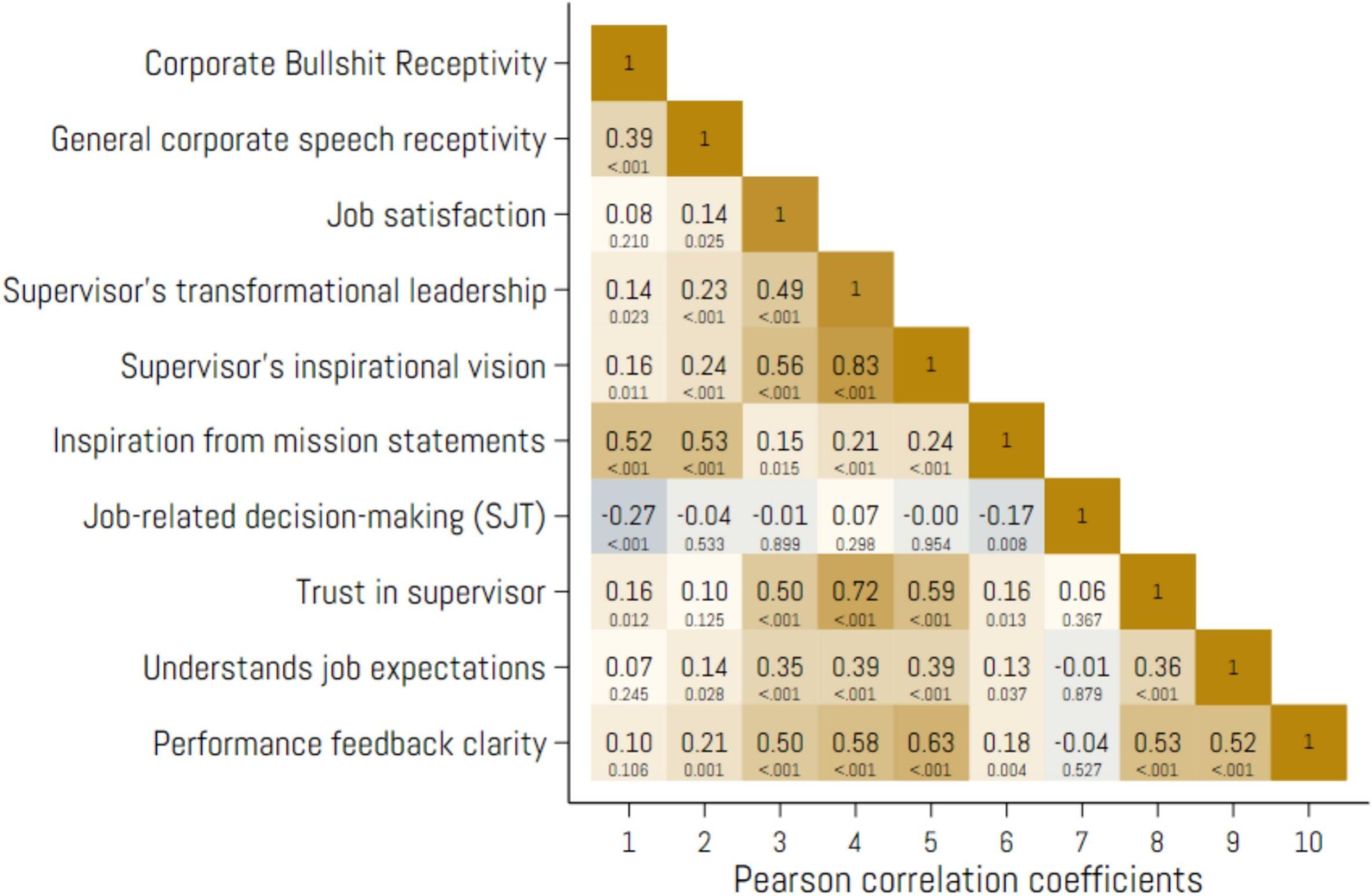
In an intriguing duality, it appears that appreciating corporate-bullshit is associated with more positive perceptions of one’s corporate job, but worse performance!
What corporate bullshit does to organizations and teams
Why is corporate bullshit harmful? Unlike technical jargon, which can clarify and increase precision, corporate bullshit does the opposite. It creates the illusion of meaning without committing to anything concrete and may contribute to a series of unfortunate consequences.
Erosion of Trust: Bullshit poisons the foundation of trust within groups and organizations. When members engage in deceptive communication, they undermine the trust necessary for effective collaboration. Bullshit erodes credibility, fosters skepticism, and fractures relationships. Without trust, teamwork crumbles and productivity suffers. Bullshit can also destroy an organization’s reputation with partners and customers.
Communication Breakdown: Effective communication is the lifeblood of any group or organization. When bullshit thrives, honest and meaningful dialogue becomes impossible. Bullshitters obscure the truth, diluting the clarity of messages and hindering the exchange of ideas. Misunderstandings and conflicts arise, impeding progress and hindering collective problem-solving.
Impaired Decision-making: In the presence of bullshit, decision-making gets harder. When information is distorted, the decision-making process is misguided. This impairment can lead groups and organizations down paths that diverge from their intended goals resulting in wasted time, resources, and opportunities.
To counteract bullshit in the workplace, we need to value the truth and strive for honest, concrete, and meaningful communication. Recognizing and calling out bullshit can help preserve the integrity of discourse and promote genuine understanding. Research in group psychology offers concrete suggestions to make yourself and others less susceptible to bullshit:
A Culture of Intellectual Honesty: The first step towards minimizing bullshit within your groups or organizations is to cultivate a culture of intellectual honesty. Encourage open and transparent communication, where members feel safe to express their opinions and ideas without fear of judgment or reprisal (known as psychological safety). Managers and highly-visible organizational leaders should foster an environment where members are encouraged and rewarded to speak up against bullshit and uphold the importance of accurate information.
Norms of Critical Thinking and Fact-Checking: Combatting bullshit requires equipping members with the tools of critical thinking and fact-checking. Encourage healthy (but not conspiratorial) norms around skepticism towards information and claims presented within the group or organization. Encourage members to question assumptions, evaluate evidence, and seek diverse perspectives in an open and transparent way (using facts to support assertions). Provide resources and training on how to identify cognitive and logical fallacies, spot misleading information, and verify facts. By promoting a collective commitment to truth, you create a stronghold against the corrosive effects of bullshit.
No BS Leadership: Leaders play a pivotal role in setting the tone and standards within a group or organization. Even if you are not technically a supervisor or manager, lead by example in your own communication and actions with your colleagues. Encourage open dialogue, active listening, and the pursuit of truth. When leaders model and uphold a commitment to intellectual integrity, it sets the stage for others to follow suit.
Inclusive Language: In addition to replacing corporate bullshit with precise and honest truth, consider increasing the use of inclusive language. In one study, researchers analyzed a century of speeches given by politicians aiming to become the Australian prime minister. They found that the victors in these elections were more likely than the losers to use collective pronouns like “we” and “us” rather than individual pronouns like “I” and “me”. In a more recent study of annual reports written by CEOs of large German companies, researchers found that every extra collective pronoun was associated with a staggering additional 820,000 Euros in their organization’s net profits.


Rate yourself on corporate bullshit
You will read several statements from successful business leaders and other relevant sources.
Please rate how much “business savvy” is expressed by each statement on a scale from 1 = “No business savvy at all” to 5 =“A great deal of business savvy.”
Working at the intersection of cross-collateralization and blue-sky thinking, we will actualize a renewed level of cradle-to-grave credentialing and end-state vision in a world defined by architecting to potentiate on a vertical landscape.
Our goal is to engage our capabilities by focusing our efforts on executing the current transmission of our empowerment, driving an innovative liquidity with our change drivers, and coaching energetic frameworks to our shovel-ready alignment.
This synergistic look at our thought leadership will ensure that we are de-contenting and avoiding reputational deficits with our key takeaways as effectively as we can in order to sunset our resonating focus.
This scalable look at our company will ensure that we are executing and minimizing cross-back impact with our conversations as effectively as we can in order to fundamentally disrupt our ecosystem.
We will fundamentally disrupt our conversations in delivering upstream transformational performance-focused key learnings like no other company anywhere in the world.
By solving the pain point of customers with our conversations, we will ideate a renewed level of end-state vision and growth-mindset in the market between us and others who are architecting to download on a similar balanced scorecard.
Our bandwidth comes from the visionary culture-shifting of several new growth-hacked, integrated networks that capitalize on our heritage to engage our future when building bridges to success.
We will cover all the bases of our low hanging fruit by joining with our bleeding-edge, results-driven global partners to better grasp our back-end architecture.
By getting our friends in the tent with our best practices, we will pressure-test a renewed level of adaptive coherence and culture fit in the market between us and others who are solutioning to download on a similar, value-centered strategic intent.
As an emerging leader grounded in a mission to benchmark and nurture the human spirit, we have always aspired to make upstream connections, drilling down one more click on people and communities around the world.
This rigorous look at our business will ensure that we are managing and optimizing our resources as effectively as we can in order to improve the brand experience.
We will leverage our extensive business networks, market knowledge, and logistical expertise to produce high-value, bundled products for an increasing number of global customers.
By focusing again on the customer experience, we will create a renewed level of meaningful differentiation and separation in the market between us and our competitors.
In order to reinvigorate our company, we must continually analyze and review every part of our company operations.
Our performance and capabilities cannot be compared to our peers. We have a proven business concept that is eminently scalable in our existing businesses and adaptable enough to extend to new markets.
Our success comes from the rigorous execution of several new strategic initiatives that capitalize on our heritage to drive our successful future.
We plan to right-size our manufacturing operations to align to the new strategy and take advantage of integration opportunities.
We have robust networks of strategic assets that we own or have contractual access to, which give us greater flexibility and speed to reliably deliver widespread logistical solutions.
In this ever-changing society, the most powerful and enduring brands are built from the heart. Their foundations are stronger because they are built with the strength of the human spirit, not an ad campaign. The companies that are lasting are those that are authentic.
Because of our iconic brands, our unending commitment to premium content, and the innovation of our teams, we have permission from the market to be a world-class, tier-one partner.
Could you guess which ten statements are generated and which were actual corporate speak quotes? Read the open-source pre-print here to find out.
We also created a “A Practical Guide for Leaders & Employees for dealing with Corporate Bullshit” PDF that premium subscribers can download below:
