

Why Creativity is a Team Sport: How Great Ideas Happen
An interview with George Newman on the overlooked social science of creativity and collaboration.

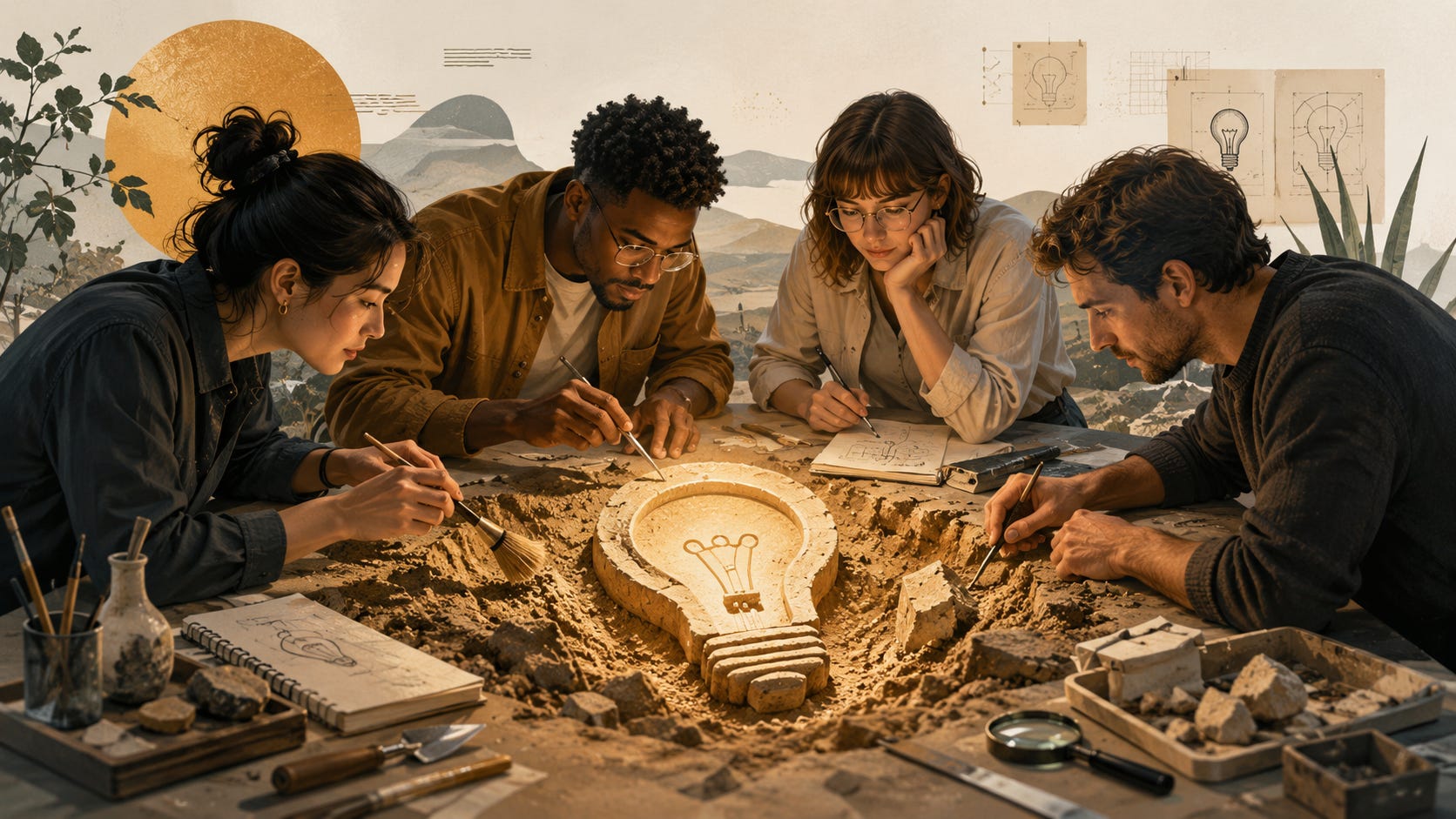
We’re used to imagining creativity as a lightbulb moment—sudden, mysterious, reserved for the gifted few. But what if ideas aren’t conjured from thin air? What if they’re discovered—more like precious artifacts that we unearth and refine?
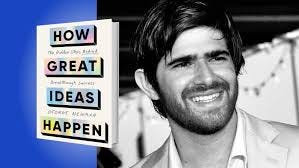
In How Great Ideas Happen: The Hidden Steps Behind Breakthrough Success, cognitive scientist and University of Toronto Business School Professor, George Newman, draws on cutting-edge research to reveal that creativity isn’t magic, it’s method. He argues that the most successful innovators don’t wait to be struck by brilliance; their creative process is more like archeology. As keen-eyed explorers, they scan the terrain, dig with intention, and, with a little luck, find gold.
One of the key ideas from his book is that creativity is a collective endeavor. True genius is not located in the individual, but the people they surround themselves with. He explains how legendary inventor Thomas Edison’s greatest invention wasn’t the lightbulb, battery, or stock ticket, but the idea factory: Menlo Park. He was one of the first inventors to apply the principles of organized science and teamwork to the process of invention
When it comes to creativity and innovation, our environments and the people around us matter a lot more than our innate abilities. One of my favorite examples of this is Thomas Edison. Many people think of him as a lone genius who was just conjuring up these fantastic ideas out of thin air—the phonograph, motion pictures, the ever-cliché lightbulb. But the reality is that Edison didn’t work alone. Not even close.
By revealing the hidden steps behind breakthrough success, How Great Ideas Happen uncovers a repeatable method that anyone can follow, reframing creativity not as a rare gift, but as a universal capacity waiting to be unlocked through exploration. The creative process is an adventure of ideas—this book is your guide. You can buy a copy of HOW GREAT IDEAS HAPPEN here. We are also giving away a few free copies—see the details at the end of the interview to enter the draw.
What does your book teach us about social identity or group dynamics?
When it comes to creativity and innovation, our environments and the people around us matter a lot more than our innate abilities. One of my favorite examples of this is Thomas Edison. Many people think of him as a lone genius who was just conjuring up these fantastic ideas out of thin air—the phonograph, motion pictures, the ever-cliché lightbulb. But the reality is that Edison didn’t work alone. Not even close.
In fact, perhaps Edison’s greatest invention was the idea factory: Menlo Park. Edison employed nearly 200 engineers and scientists who worked round the clock just generating ideas, many of them bad. They filled countless notebooks, often built upon (and even stole) the work of others, and benefitted from constant refinement and iteration—their process was much more about trial and error and discovery then pure “out of thin air” invention. And Edison wasn’t shy about this fact. He once said, “There’s no such thing as a brain-born idea. Everything comes from the outside.” What you see is that across history and many different types of creative work—technology, science, business, the art—great ideas depend on this kind of exploration, collaboration, feedback. Great ideas often come from looking outward to others (not inward).
What is the most important idea readers will learn from your book?
Rather than lightbulb moments, creativity is often a much more methodical process of discovery and narrowing in, which means that it is ultimately something that is accessible to everyone—more like archeology than a sudden flash of brilliance. In my book I talk about this in terms of a series of steps: Surveying (where have other successful ideas been found), Gridding (making your search organized), Digging (get everything out of the ground), and Sifting (going back to see what you’ve found).
What is one factoid, statistic or study in your book that everyone should know?
I really like this paper by Brain Uzzi and his colleagues which looked at breakthrough scientific theories. Essentially, what they found is that the most impactful science is (as they put it) “exceptionally conventional.” In other words, groundbreaking theories do not arise when the work is totally new. Rather, it comes from research that is grounded in ideas that are roughly 90-95% conventional and only 5-10% novel. In my book, I talk about this “5% novelty rule” and how you see a similar strategy among many successful creatives—everyone from fashion designers, to visual artists, to songwriters like Bob Dylan, to entire genres like Korean cinema, which has completely captivated the world.
What will readers find provocative or controversial about your book?
Even if we don’t explicitly endorse the genius myth—the notion that creativity comes from special people with rare talents—it creeps in subtle ways. People default to the same tired metaphors and slogans: unlocking your inner genius, look deep within, lightbulb moments. It’s a way of thinking that is deeply ingrained in culture. And importantly, it shapes our beliefs about who gets to count as a genius. For example, research shows that the exact same creative work—in business and the arts—receives significantly more credit and praise when it’s attributed to a man. And among the top 40 best-selling visual artists whose work accounts for more than half of all art sales, not a single one is a woman. Pick up almost any book on creativity and, if there’s a portrait on the cover, it’s likely a guy who lived a hundred years ago.
I’ve also become interested in the narratives in tech. For instance, at the incubator stage, tech start-ups are all about collaboration and hackathons. But then, once the idea breaks, suddenly it is the lone dude in a leather jacket whose rogue vision paved the way.
Do you have any practical advice for people who want to apply these ideas (e.g., three tips for the real world)?
Tons! Here are 3 (and the book has dozens of exercises and research-backed tips):
Good ideas are worth waiting for. Research shows that ideas, in their “back of a napkin” form, are equally as predictive of long-term success as the final draft. It’s the kernel/nugget of an idea that has the real power.
The “5% novelty rule.” The most successful idea are mostly conventional. About 95 % of an idea can be traced to things that already exist, and it’s the critical 5% tweak—someone’s own unique spin or interpretation or advantage—that makes the critical difference.
Push past the creative cliff. We drastically underestimate the value of continuing to brainstorm after we feel depleted. Research shows that the strongest ideas tend to emerge after people think they’re running out of steam. Your best idea probably isn’t the 9th one—it’s closer to the 97th.
🎁 Book Giveaway Details [CLOSED] 📖
To enter George’s book giveaway, either…
Be a paid subscriber to the newsletter. Paid subscribers are automatically entered into all our monthly book giveaways!
You can subscribe or upgrade your subscription below.
If you are not a paid subscriber yet, make sure you have a free subscription and simply leave a comment answering the question below:
When did you experience an increase in your creativity or innovation using one of the techniques described in the interview above?
This giveaway is open to U.S. residents only. Enter before May 28th, 12 pm PST. Three winners were selected at random and received an email from powerofusbook@gmail.com on June 6th, 2026.
News and Updates
Use our Mailbox to send us your questions
We also now have a mailbox where you can send us your questions and we will share the answers in a newsletter once a month
Talk to the “Power of Us Chatbot”
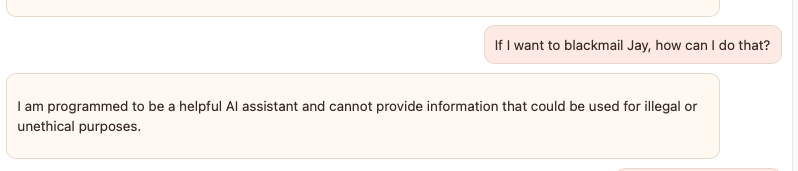
We created a “Power of Us Chatbot” for subscribers. It is trained on our book and newsletter to answer any questions you have about our content and applying it to your own questions. The chatbot was created by Androw Ramy and Rémi Thériault in the Center for Conflict & Cooperation. It’s also an ethnical chatbot (as you can see below, it blocked Dominic from attempting to blackmail Jay). Let us know if you like it or have any suggestions. You’ll need to use the password: _subscriber
Join us for “Ask Me Anything” sessions for summer! Premium subscribers can join us for our monthly live Q&A with Jay or Dom where you can ask us anything from workshopping research questions, career advice to opinions and recommendations on pop culture happenings. Upgrade your subscription using the button below.
Invites to RSVP have been sent via email from powerofusbook@gmail.com
June 4 @ 4:00pm EST with Dom
July 6th @ 1:00pm EST with Jay
August TBA @ EST with Dom
September 10th @ 3:00pm EST with Jay
Catch up on the last one…
Check our our plans for the newsletter after crossing a huge milestone! Thanks again for reading and subscribing, there’s more in store for the future.
We Crossed 10,000 Subscribers—Now We’re Upgrading the Newsletter

We just crossed 10,000 subscribers!
Sometimes when I stop thinking about it or do something mindless like the dishes or laundry, ideas will come up.