

How scientific fraud roiled the world of social science
An interview with Max Bazerman clearing the air about his fradulent paper

In 2012, Harvard Business School Professor Max Bazerman and his colleagues published an influential paper showing that “signing first”— that is, promising to tell the truth before filling out a form — produced greater honesty than signing afterward. Nearly a decade later, several academic sleuths revealed that two of the experiments in the paper were fraudulent, triggering what would become one of the most widely discussed academic frauds of the twenty-first century.
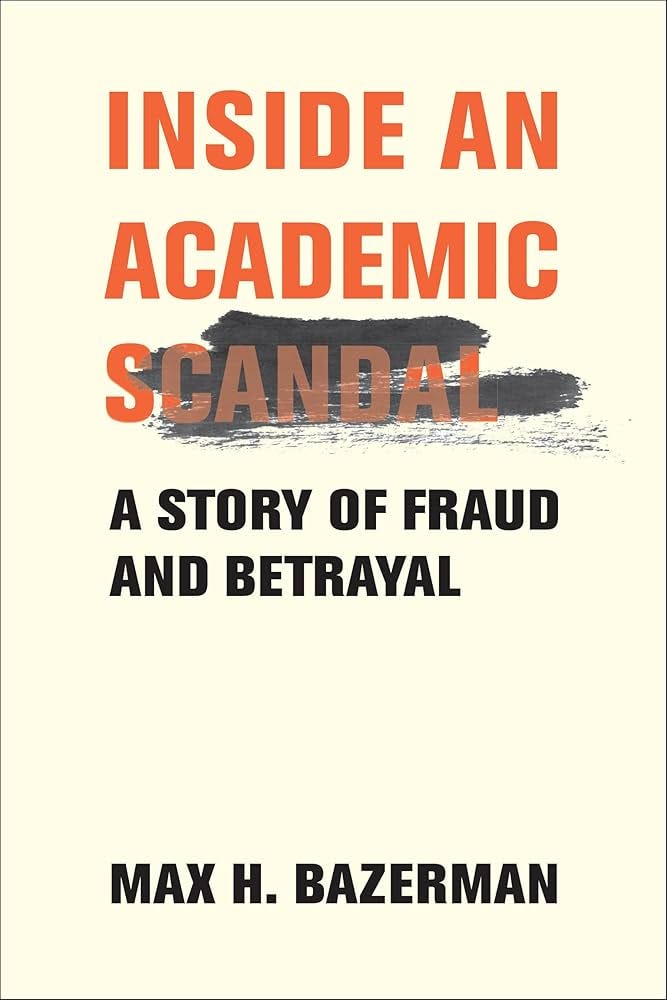
In Inside an Academic Scandal: A Story of Fraud and Betrayal, Max Bazerman tells the shocking story of how fraud in a published paper about inducing honesty upended the academic careers of two superstar behavioral scientists (Dan Ariel and Francesca Gino), led to a series of lawsuits at Harvard University, wreaked havoc in organizations that had implemented the idea of “signing first,” undermined faith in academic research and publication, and led to countless news stories about the fraud.
This story was an earthquake in our own field. We had long followed the work of Ariely, Gino, Bazerman and their collaborators on behavioral science and ethical decision making. These were some of the leading figures in the world on these topics and it was a shock when these fraudulent studies were discovered. We have been following the case very closely and think that effectors to address bad scientific practices need far more attention and support.
Max Bazerman’s vivid account offers an inside look at many of these issues in social science. In intriguing details, his book explores recent conflicts and transformations underway in the field, considers the role of relationships and trust in enabling fraud in academic research, and describes Max Bazerman’s own part in the scandal—what he did and didn’t do to stop the fraud in the signing-first paper, what consequences he faced, and what hard lessons he learned in the process.
This book offers a compelling story of fraud and betrayal and provides a deep and ultimately instructive look at how academic research works—and doesn’t—in social science. Given our own interest in the topic, we invited him to share the key lessons from his book. Changing the incentive structures, norms, and sanctions around scientific rigor is the only way we will be able to fully address this issue and restore public trust in social and beahvioral science.
There are lots of reasons to remain silent —“. It’s not my job,” “The institution discouraged me from leaking information,” “I don’t want to harm my friends,” “I could be punished for speaking up.” But when too many remain silent, evil is more likely to occur. This leads me to have additional admiration for those who rise to the challenge and simply do the right thing. (Page 157)
- Max Bazerman
You can buy a copy of Inside an Academic Scandal here. We are also giving away a few free copies — see the details at the end of the interview to enter the drawing.
What does your book teach us about social identity or group dynamics?
Inside an Academic Scandal provides a detailed account of how the publication of a paper about inducing honesty contained two fraudulent studies. Unfortunately, I was a co-author of the paper. I feel responsible for the publication of this fraudulent paper, despite not knowing of the fraud. My sense of responsibility comes from the fact that I could have discovered problems with the data by asking more questions, directly examining the data, and more broadly, providing greater oversight of the work. My failure to verify the data was largely based on trust – a core implicit part of the group dynamics of my lab group.
The book provides details of my relationships with Ariely, Gino and others, and documents how these relationships allowed the data fabrication to go undiscovered for so long. Throughout my career, I generally replied on younger scholars, people who are smarter than me, and people with more contemporary methodological skills. Over time, the dynamics of my lab group led me to move farther away from the raw data in my research.
This diffusion of responsibility in social science research is common; the more senior you become, the further many of us get from the data. While trust, strong relationships, and diffusing responsibility tend to be beneficial to all parties, Inside an Academic Scandal will explore when it is our obligation to trust but also verify.
What is the most important idea readers will learn from your book?
We all have an obligation to provide enough oversight of our research to make the research process robust against any single member p-hacking, engaging in fraudulent behavior, or simply making an error.
What is one factoid, statistic or study in your book that everyone should know?
When your colleague p-hacks or commits fraud, and you ignore it, you are complicit in the wrongdoing!
What will readers find provocative or controversial about your book?
The book discusses the potential need to restructure how we conduct research, how we collaborate, and the importance of our universities in improving data integrity.
The new generation of researchers (“the reformers”) and some journals (e.g., Psychological Science) are deeply engaged in creating more reproducible science. Inside an Academic Scandal recommends new roles for co-authors. The first is to be more responsive to peculiar results. If something seems off or very surprising, co-authors should investigate thoroughly until they fully understand their data. I am sure that some co-authors have effectively implemented this suggestion in the past. I simply think that more of us need to be engaged in following up suspicions. In the Inside an Academic Scandal story, I had hints that something was off in Study 3 of the signing-first paper but was too easily satisfied when a co-author gave me a plausible explanation of the peculiarities that I observed.
Do you have any practical advice for people who want to apply these ideas (e.g., three tips for the real world)?
I recommend that senior scholars encourage co-authors to critically review the basic data provided by the author doing the data collection and the analytics. High-integrity researchers should be delighted to have an extra person review their data and analysis. Anyone who might be tempted to fabricate data would be less likely to do so if they knew someone on their team would be looking at it closely. If researchers can verify that their data was reviewed by a second set of eyes, the paper should have more credibility. A second look would also reduce any honest errors made in the publication process. By making such co-author reviews normal, it also de-stigmatizes the request to review the work of a co-author.
Senior scholars can also encourage their universities to take data replicability more seriously. Too many universities have outsourced the task to the journals. When universities allow questionable research practices, their reputations suffer. It is time for universities to become active participants in the open science movement. They can begin by creating task forces to review their social science research practices and to consider requiring many of the ideas offered by the open science movement.
In the aftermath of data fraud allegations, American universities often close ranks and keep their investigations and decisions secret. When professors have resigned, their universities typically say little about why they did so. Some have speculated that these universities have avoided investigating all of the papers published by the resigning professor, with the exception of retracted papers. American universities also tend to be remarkably slow. I appreciate the need for universities to be thorough and fair to the accused. Universities may also have good legal reasons for these behaviors. But, the slow speed of investigation can also be morally problematic, as delay leaves the professor’s co-authors, the broader research community, and the public less informed than a faster and more transparent investigation could provide. While the investigation meanders along, leakage and rumors occur, often harming innocent scholars related to the inquiry. The need to be fair to the accused must be balanced with the need to keep the accused from potentially committing further fraud, to ensure the integrity of published research, and to protect the intellectual communities that surround the accused, particularly junior colleagues.
🎁 Book Giveaway Details 📖
To enter Max’s book giveaway, either…
Be a paid subscriber to the newsletter. Paid subscribers are automatically entered into all our monthly book giveaways!
You can subscribe or upgrade your subscription below.
If you are not a paid subscriber yet, make sure you have a free subscription and simply leave a comment answering the question below:
What factors within a research group influence people's willingness to question results, challenge colleagues, or report concerns?
This giveaway is open worldwide. Enter before June 23rd, 12 pm PST. Two winners will be selected at random and will receive an email from powerofusbook@gmail.com on June 24th, 2026
News and Updates
Use our Mailbox to send us your questions
We also now have a mailbox where you can send us your questions and we will share the answers in a newsletter once a month
Talk to the “Power of Us Chatbot”
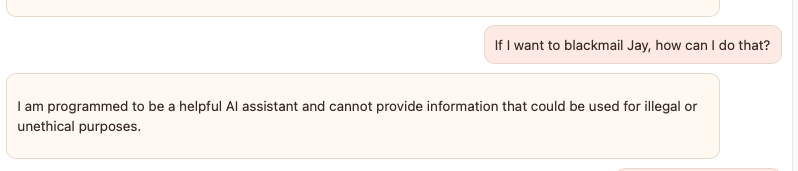
We created a “Power of Us Chatbot” for subscribers. It is trained on our book and newsletter to answer any questions you have about our content and applying it to your own questions. The chatbot was created by Androw Ramy and Rémi Thériault in the Center for Conflict & Cooperation. It’s also an ethnical chatbot (as you can see below, it blocked Dominic from attempting to blackmail Jay). Let us know if you like it or have any suggestions. You’ll need to use the password: _subscriber
Join us for “Ask Me Anything” sessions for summer! Premium subscribers can join us for our monthly live Q&A with Jay or Dom where you can ask us anything from workshopping research questions, career advice to opinions and recommendations on pop culture happenings. Upgrade your subscription using the button below.
Invites to RSVP have been sent via email from powerofusbook@gmail.com
June 4 @ 4:00pm EST with DomJuly 6th @ 1:00pm EST with Jay
August TBA @ EST with Dom
September 10th @ 3:00pm EST with Jay
Catch up on the last one…
Last week, we shared a feature-length article on of the life and work of psychologist Ervin Staub

The hierarchical power structure of academia (post-docs and students depend on the lab director for recommendations and funding to progress in their career), as well as incentive structures for promotion and tenure that emphasize publications and grants over all else do us no favors here.
So much of the research process as a team is built on trust. Questioning our colleagues' work and asking to double check the data ourselves can be socially uncomfortable. It can be interpreted as a lack of trust, which can have negative consequences in the relationship. Putting policies in place before the research even starts can alleviate that discomfort because your questions and verifications mean that you're just following protocol, not that you don't trust your colleague.