

Can AI Help Us Find the Books That Bridge Political Divides?
We used language models to screen 26 nonfiction books. They agreed on the broad winners, disagreed on the details, and helped us choose two finalists for a human trial.


Last fall, we proposed a simple research question: can reading the right nonfiction book make people less polarized and more compassionate toward those who see the world differently?
This matters because books are unusually scalable interventions. They are already written, widely available, and easy to bring into classrooms, workplaces, reading groups, or people’s daily routines. Yet nonfiction books written explicitly to change how people think and act have received far less scientific attention than fiction. That left us with a practical question: among all these plausible books and chapters, which ones should real people read first?
“Can reading the right nonfiction book make people less polarized and more compassionate toward those who see the world differently?”
Our project quickly ran into a practical problem. There are numerous books about empathy, identity, moral disagreement, and bridging divides, each containing many chapters. A serious research project requires time, money, participants, and author permissions. We did not have the resources to ask hundreds of people to read every promising candidate. Before testing a book, we needed a principled way to choose the most promising book(s) for reducing partisan animosity.
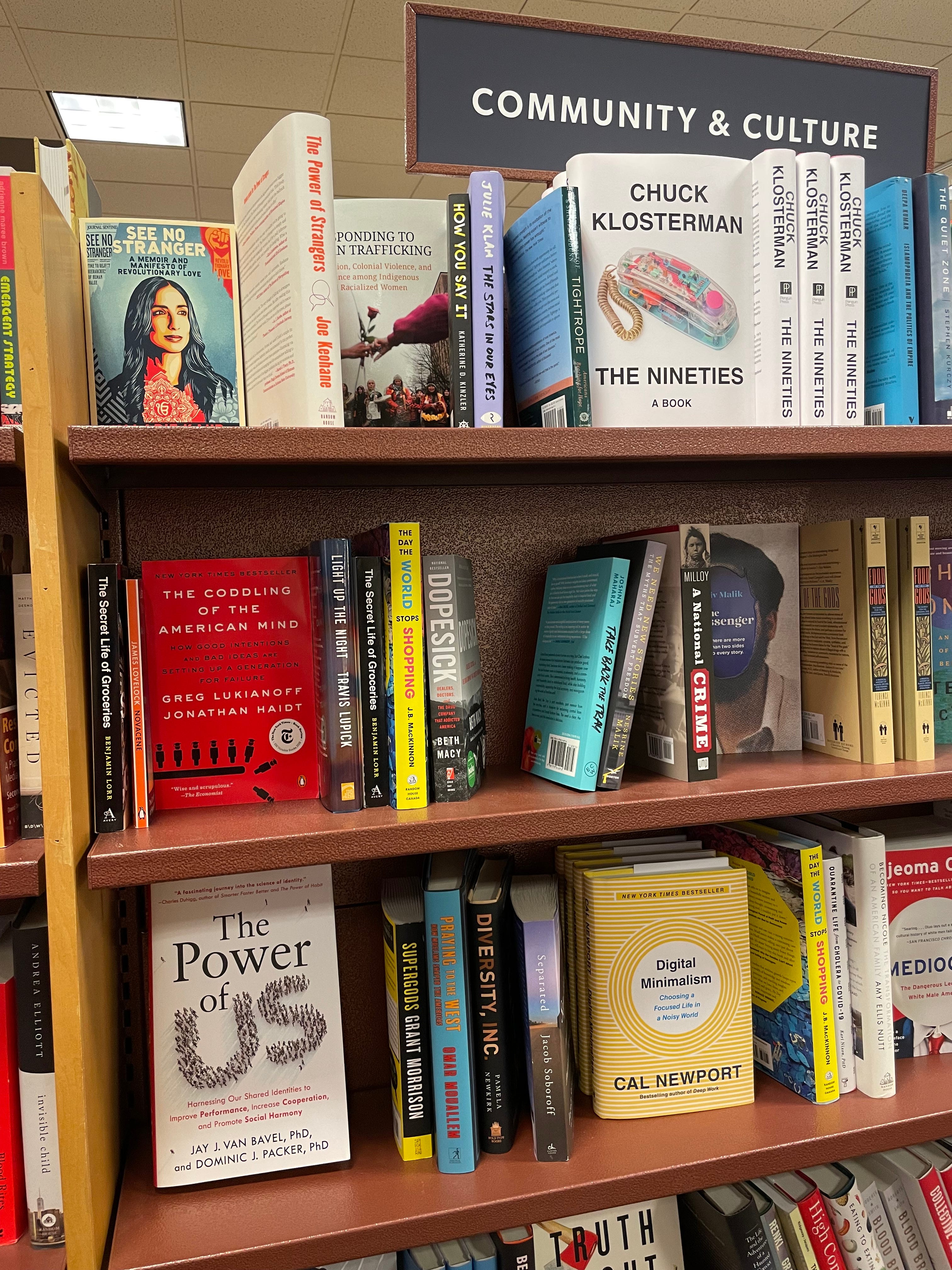
We decided to reach out to potential authors and give them an opportunity to participate in a friendly competition: we would run simulations using artificial intelligence to determine which books had the biggest potential impact. The simulations would narrow the field, and real readers would determine the winner.
AI as a First-Round Reader
We use large language model simulations not as a substitute for people, but a filter to help select the books that might be most effective. There is promising precedent for this approach. In a recent paper at Nature, our former NYU colleague Ashwini Ashokkumar and colleagues found that GPT-4 simulations correlated strongly with results from actual social science experiments (r = .85), even for unpublished studies. The models tended to overestimate effect sizes, but the approach was extremely effective for determining which treatments would work best.
That limitation shaped our strategy. First, we ranked books and chapters rather than treating simulated effect sizes as literal forecasts. Then we looked for consensus across models, reducing the chance that one model’s quirks would determine the winner. The goal was not to declare that a book “works.” It was to find the candidates with the most promise for real world testing (which will be very expensive and time consuming).
The simulations would narrow the field, and real readers would decide what happened next.
We assembled a pool of 26 prosocial nonfiction books using expert input, AI suggestions, author recommendations, permissions, and through personal contact with authors. We got author permission to use these books and ensured they were not used for training purposes by commercial models. We also included several control nonfiction books, like Jerks at Work, Job Therapy, and How Not to Age, to ensure the models were providing null estimates where appropriate. We also added Power of Us into the mix.
The final list of books (with authors in parentheses) were: (1) Facing the Fracture (Tania Israel); (2) Lovingkindness (Sharon Salzberg); (3) Beyond Your Bubble (Tania Israel); (4) I Never Thought of It That Way (Mónica Guzmán); (5) Why Are We Yelling? (Buster Benson); (6) The Righteous Mind (Jonathan Haidt); (7) High Conflict (Amanda Ripley); (8) Love Your Enemies (Sharon Salzberg and Robert Thurman); (9) A Heart as Wide as the World (Sharon Salzberg); (10) War for Kindness (Jamil Zaki); (11) Hope for Cynics (Jamil Zaki); (12) Be You (Cirak); (13) Outraged (Kurt Gray); (14) God Is a Conservative (Cirak); (15) The Evolution of Cooperation (Robert Axelrod); (16) Klan Whisperer (Daryl Davis); (17) Power of Us (Jay J. Van Bavel and Dominic J. Packer); (18) Moral Tribes (Joshua Greene); (19) Blueprint (Nicholas A. Christakis); (20) The Better Angels of Our Nature (Steven Pinker); (21) The Expanding Circle (Peter Singer); and (22) Why Nations Fail (Daron Acemoglu and James A. Robinson)
We also included several control books: (21) Jerks at Work (Tessa West); (23) Job Therapy (Tessa West); (24) How Not to Age (Michael Greger); and (25) The Brass Check (Upton Sinclair);
Then, chapter by chapter, we asked several models to simulate American Democrats and Republicans (using an R package Remi developed, called nalanda). Each simulated reader rated their warmth toward both parties, “read” a chapter, and rated them again. Our outcome was the change in affective polarizaton—the warmth gap between political ingroup and outgroup. A smaller gap after reading made a chapter more promising as an intervention.
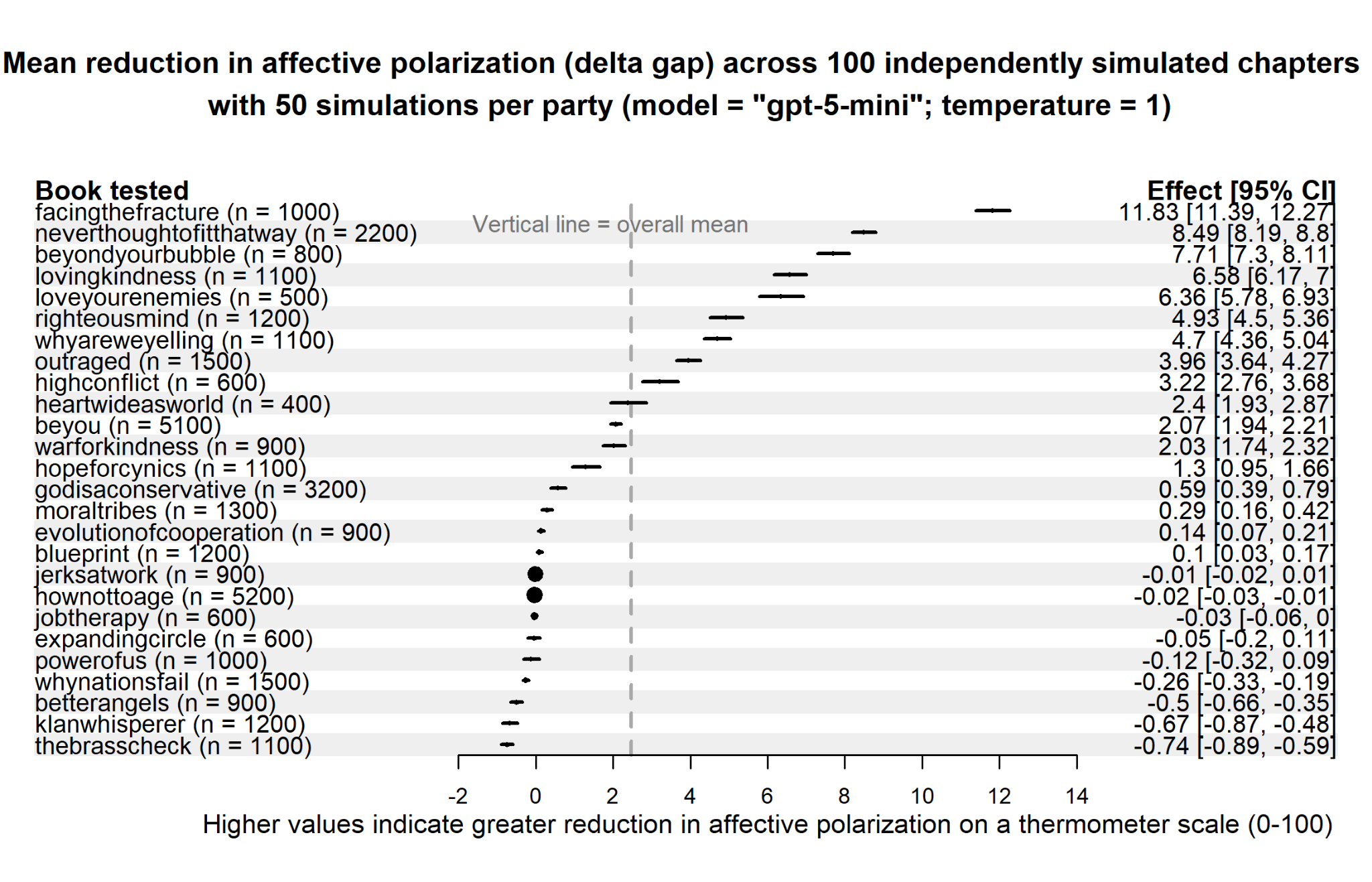
To reduce randomness, we used fixed seeds and temperature 0 wherever supported (gpt-5-mini only supports a temperature of 1). The process was still messier than it sounds. Some models refused to adopt a partisan identity (presumably for safety reasons), others flagged particular chapters, and repeated runs varied because of cost and interrupted jobs. We treated these outputs as a screening signal, not a precise estimate of what a human reader would feel and you should take the effect size estimates with a grain of salt. Before combining models, we first examined what an individual model seemed to say, with GPT-5 mini below as a case example. You can see that “Facing the Fracture” appeared to be the most effective at reducing affective polarization.
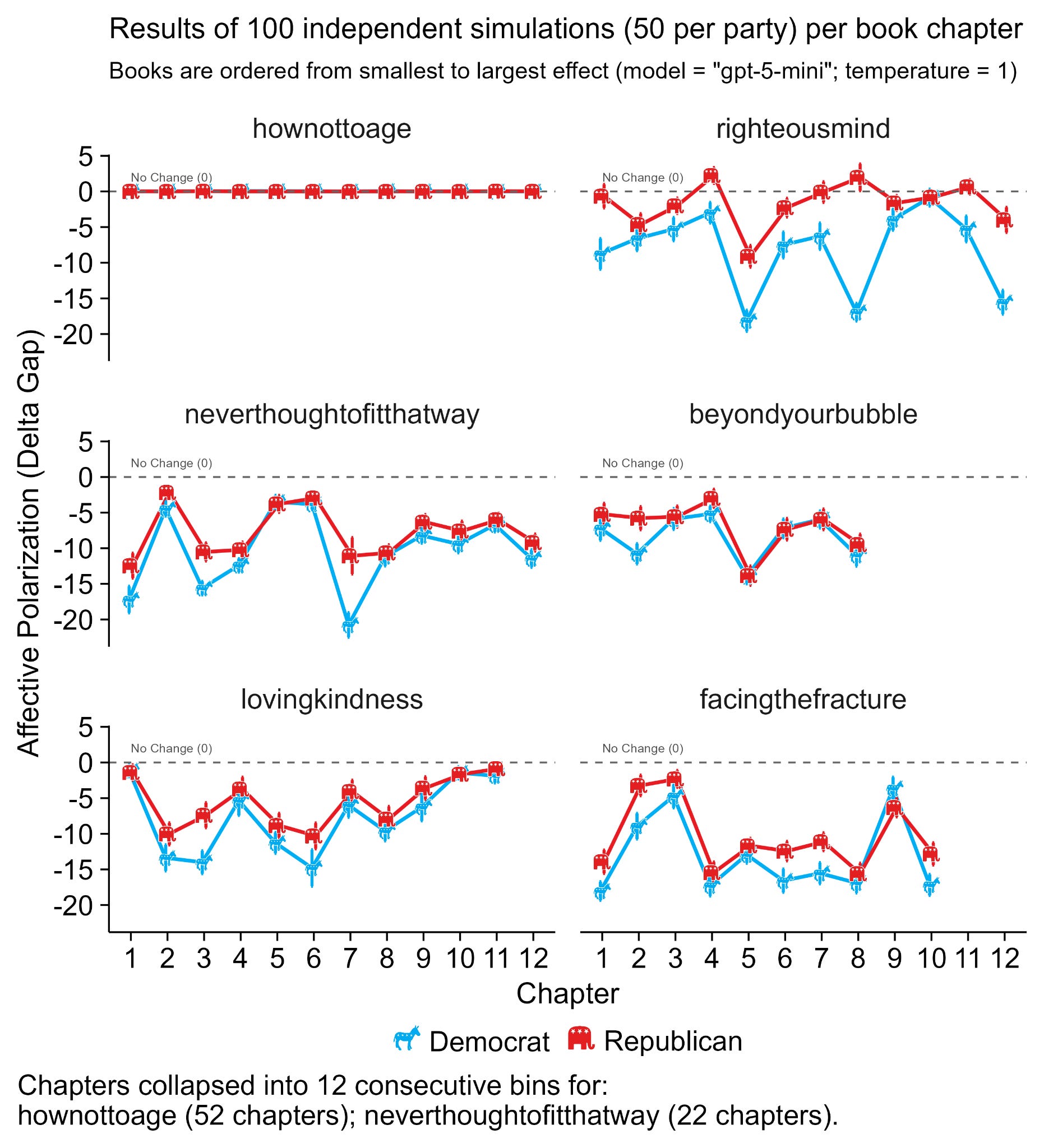
We then examined the results at a finer level. The next figure shows how the simulated chapter effects differed for Democrats and Republicans across six illustrative books. This view reveals possibilities that a single book average can hide, but it is also noisier and more sensitive to the model and chapter selected. It also shows that one of our control books ("How Not to Age”) had no impact on affective polarization for either party. This is an important sign that our simulations are not reacting selectively to relevant content.
The AI Models Agreed Until They Didn’t
Then came one of the most interesting questions in our investigation: did the AI models agree with one another?
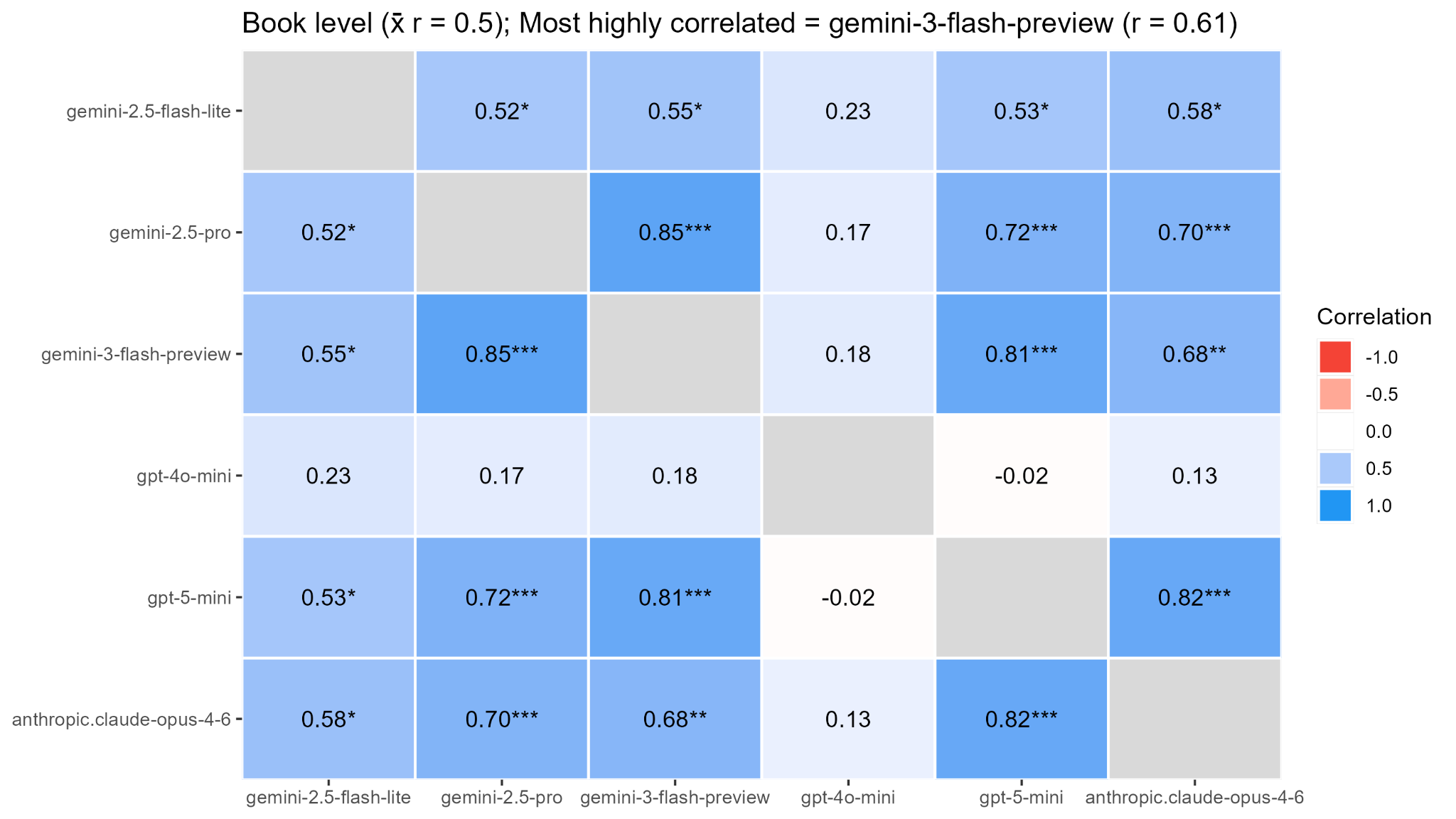
They agreed most on the broad choice of book and less as the decision became more specific. Across the five models used in our primary consensus, the average pairwise correlation was r = .68 at the book level, but only .48 at the book-by-chapter-by-party level. In other words, the models agreed more about which books to read than about what chapters to prescribe to a reader.
One model, GPT-4o mini, barely tracked the others. Rather than quietly averaging all six together, we based the primary ranking on the five models that showed meaningful convergence and kept the sixth as a useful warning: “an LLM result” is not a single, interchangeable thing. Consensus does not guarantee that the five models are correct, but disagreement is information too.
The Books That Rose to the Top
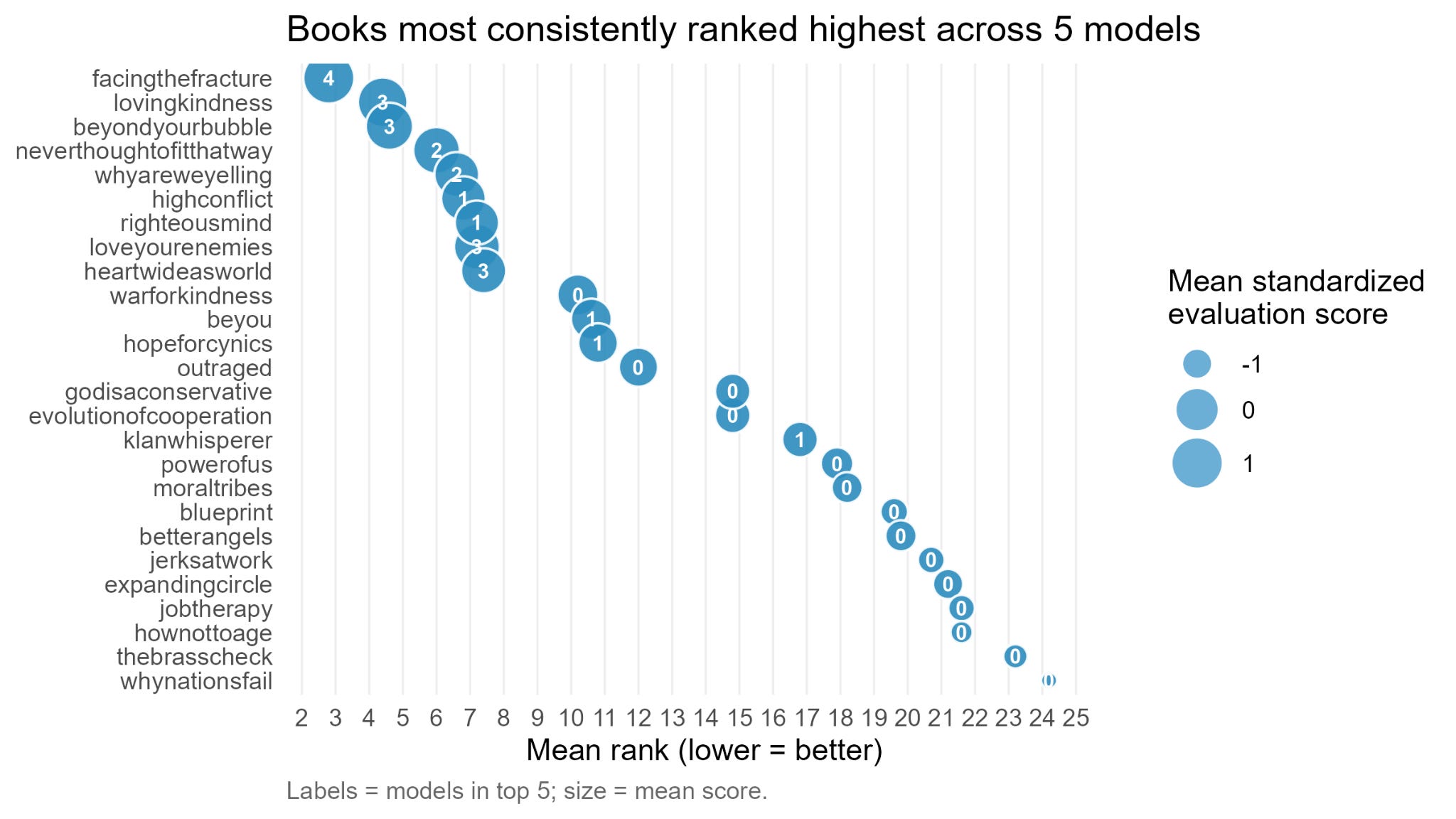
Three books rose most consistently to the top of every simulation: Tania Israel’s Facing the Fracture and Beyond Your Bubble, and Sharon Salzberg’s Lovingkindness. Other books about moral conflict and social repair also ranked highly, including Why Are We Yelling?, The Righteous Mind, High Conflict, and Love Your Enemies.
A Ranking Is Not a Decision
The AI model ratings were our strongest signal, but not our only criterion for selecting a book. A book also has to be readable, practical, engaging, and capable of supplying at least one excellent chapter. We standardized each dimension to a common scale and combined them in a weighted rubric.
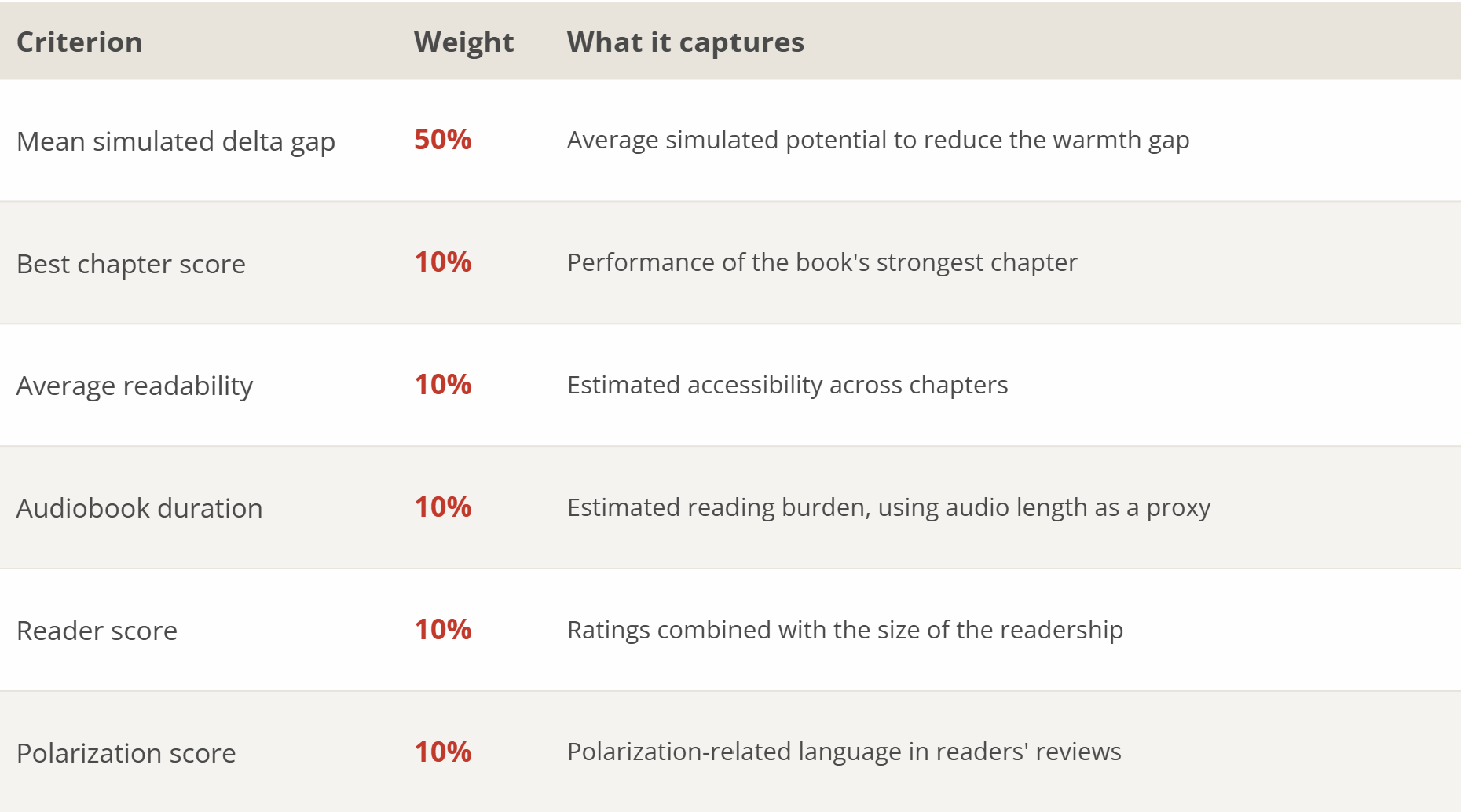
Some of these criteria were straightforward. We used audiobook duration as a proxy for how long each text would take to read (although participants in our study will read the books, not listen to the audiobooks). Every book also received credit for the standardized score of its strongest chapter, and we used Gemini 3.1 Flash Lite to estimate chapter readability.
Others required more invention. The reader score combined star ratings from Amazon and Goodreads with review volume, rewarding books that were both well received and widely read. For the polarization score, we analyzed review language in 1,000-token segments using the Negative Affective Polarization Dictionary. This captures polarized reactions among readers, not whether the book itself is “polarizing.”
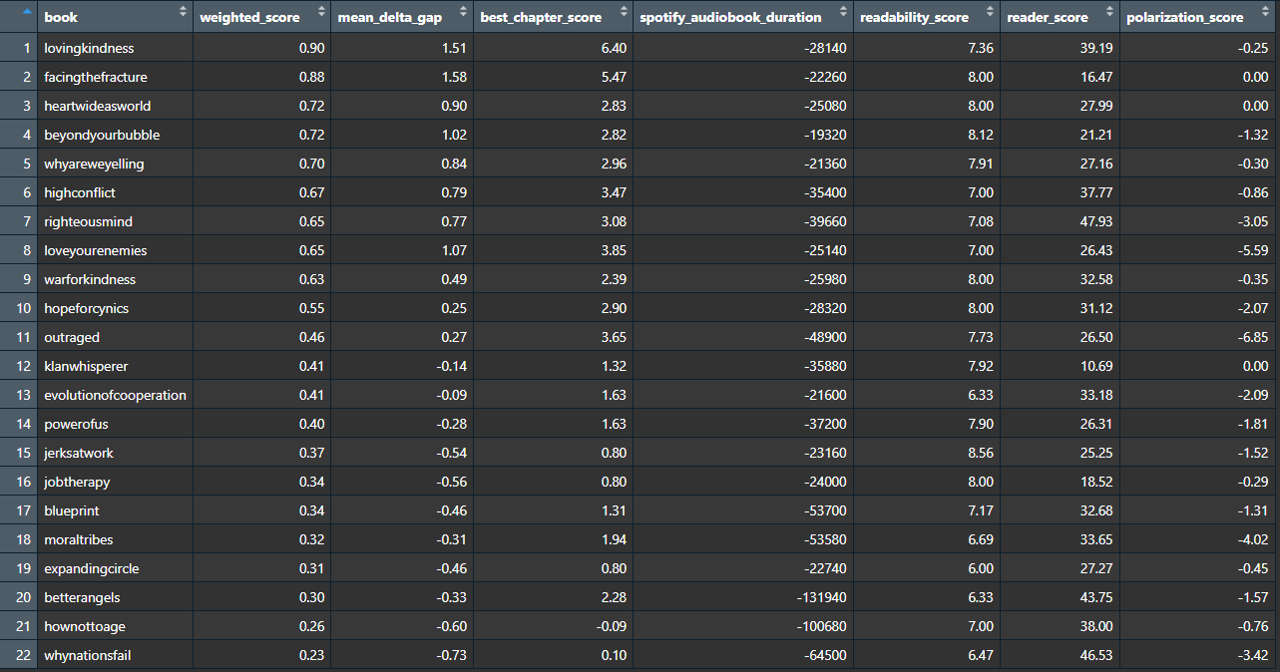
The broader rubric produced a useful result: Facing the Fracture and Lovingkindness tied for first place (weighted score = .87). Rather than elevating one over the other, the expanded criteria confirmed them as a shared top tier after feasibility, readability, reader response, and review language were added. That convergence gave us a clear reason to test both.
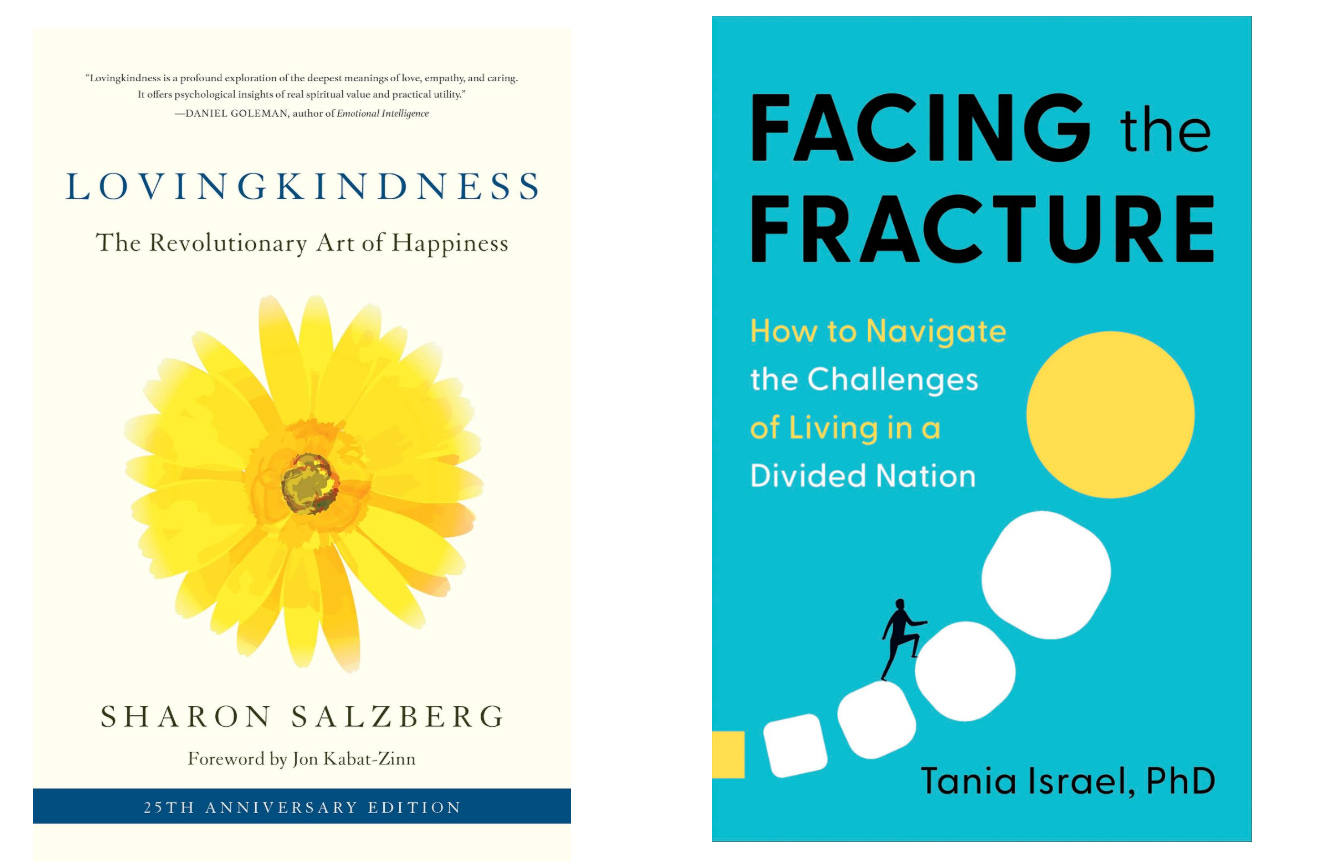
Testing two active books also makes the pilot a genuine second round of the competition. With only one, human data could tell us whether that chapter beats the controls, but not which finalist performs better. The contrast also matters beyond the competition: Facing the Fracture speaks directly to the political realities of the United States, whereas Lovingkindness offers a more general approach to intergroup interactions and is available in translation. If they prove equally effective, Lovingkindness may be easier to apply across countries.
From Books to Chapters
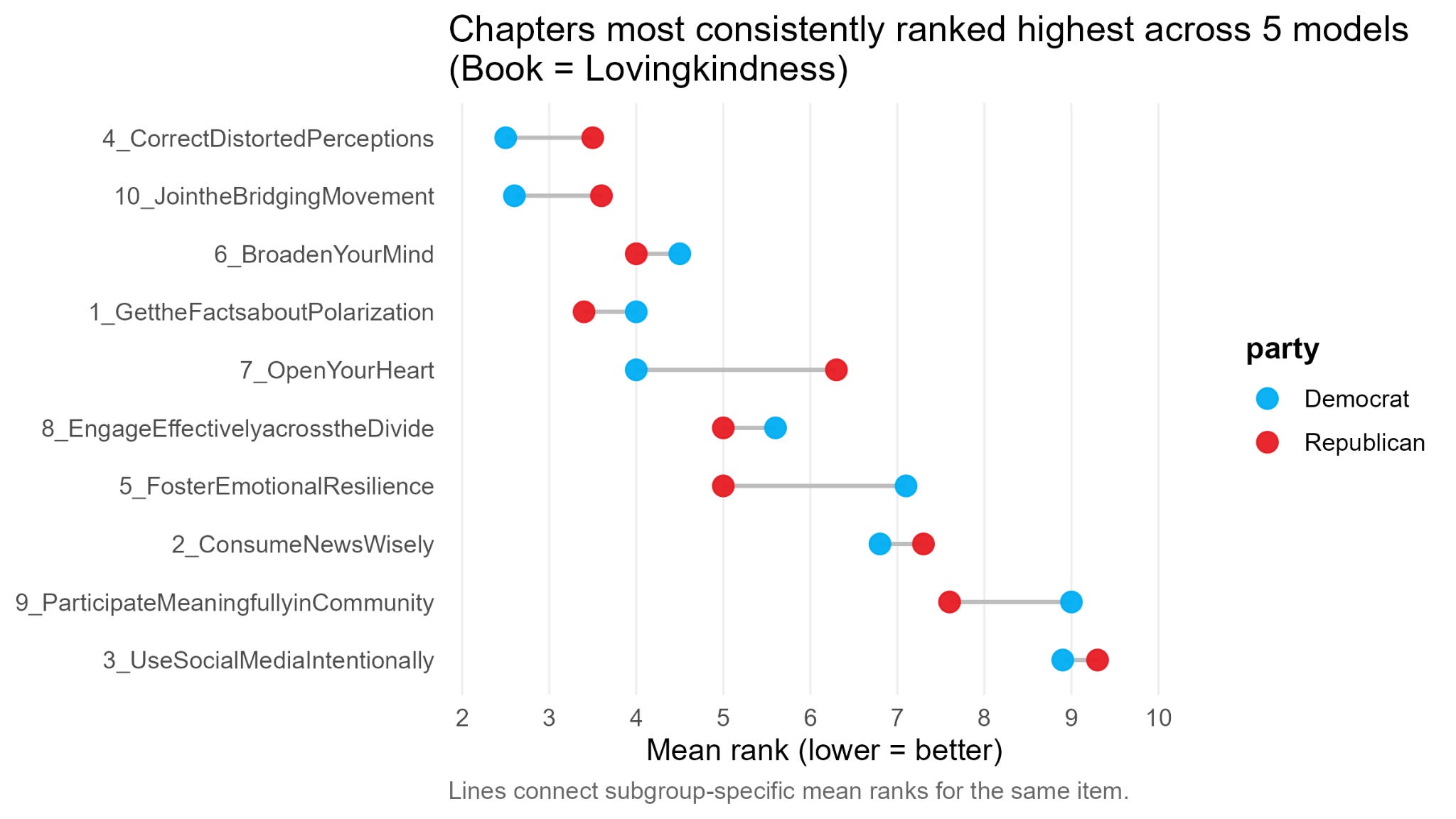
The finalists point toward two different psychological routes. In Facing the Fracture, Chapter 4, “Correct Distorted Perceptions,” ranked highest. It targets a well-known problem in political conflict: people often imagine the other side as more extreme and hostile than it really is. In Lovingkindness, Chapter 6, “Breaking Open the Loving Heart,” offers a complementary route by cultivating concern beyond one’s usual circle.
Now, the Human Test
Round two of our study will involve roughly 1,000 U.S. adults in a planned one-hour online pilot. They will be randomly assigned to read one of the two finalist chapters, read the “Diet” chapter from Michael Greger’s neutral nutrition book How Not to Age, or take a smartphone break. The reading groups will also see a short video summary and complete a chatbot-guided reflection.
We will measure political warmth, behavioral choices involving political ingroup and outgroup members, open-mindedness, identification with humanity, and related democratic attitudes and behaviors. The deeper hypothesis is that a book can widen the reader’s sense of “we,” helping people see themselves not only as Democrats or Republicans but as members of communities that cross the political divide. The pilot is planned for the end of summer, and its preregistration is in progress.
What Comes Next
If the pilot identifies a promising candidate, the final round of our study is a 10-week randomized controlled trial in which participants will read daily excerpts and listen to weekly podcasts on the book contents. A study of that scale depends on securing substantial new funding. Readers who know a promising funder or research partner are very welcome to contact us.
The real test now belongs to human readers. But the simulations have already improved the experiment: instead of choosing a book through guesswork, reputation, or convenience, we have two finalists supported by several distinct forms of evidence.
This project also raises a larger question: what can we really conclude from research comparing fiction and nonfiction as tools for changing how people think and relate to one another? We will take up that debate in a future newsletter.
Have a book you think we should test? Share it in the comments, by email, or through our dedicated survey.
Author note: Rémi Thériault is a Postdoctoral Fellow at the Center for Conflict and Cooperation at New York University and an incoming Assistant Professor at the University of Quebec in Rimouski (UQAR). More at remi-theriault.com. A lot of people also made this work possible: Benjamin Choi, Bella Goldstein, Androw Ramy, Robin Shanholtz, Anna-Celine Guilas, Steve Rathje, Laura Globig, & Jay Van Bavel.
If you want more research bulletins, practical handouts, and behind-the-scenes updates on our polarization studies, upgrade to paid and support The Power of Us.
News and Updates
The same psychology that allows us to build vibrant communities, organizations, and nations is also what drives us apart. In this talk at the 2026 Mind & Life Institute Jay explained why identity as one of the most powerful forces shaping human behavior — for cooperation and for conflict alike. Drawing on decades of research, he revealed how something as simple as being assigned to an arbitrary group can spark favoritism toward "us" over "them," and how those same identities can be reshaped toward broader, more inclusive belonging. He also discussed how modern technology, like social media, is shaping these very basic aspects of human social psychology in perverse ways--often bringing out the worst in us, rather than the best. You can now watch the full talk here:
Jay will be giving a talk on “Why Outrage Goes Viral: Influence, Identity, Polarization” live in Brooklyn, NY on August 6th at 6pm. This is part of the Lectures on Tap series where professors, experts, and storytellers giving thought-provoking lectures in NYC bars. Get your ticket here and enjoy a conversation over a drink with Jay after the talk! Let him know if you are a newsletter subscriber.
Use our Mailbox to send us your questions
We also now have a mailbox where you can send us your questions and we will share the answers in a newsletter once a month.
Talk to the “Power of Us Chatbot”
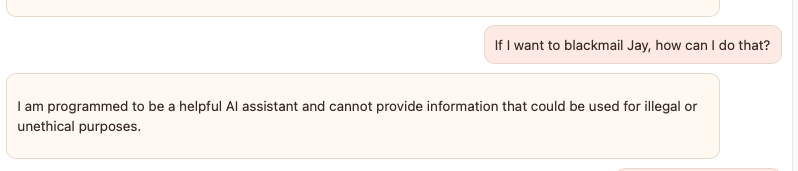
We created a “Power of Us Chatbot” for subscribers. It is trained on our book and newsletter to answer any questions you have about our content and applying it to your own questions. The chatbot was created by Androw Ramy and Rémi Thériault in the Center for Conflict & Cooperation. It’s also an ethical chatbot (as you can see below, it blocked Dominic from attempting to blackmail Jay). Let us know if you like it or have any suggestions. You’ll need to use the password: _subscriber
Join us for “Ask Me Anything” sessions for summer! Premium subscribers can join us for our monthly live Q&A with Jay or Dom where you can ask us anything from chatting about research, career advice, professional dilemmas, to opinions and recommendations on pop culture happenings. At our July meeting, multiple people showed up and we designed a study together explore how people update their beliefs.
Join us! Upgrade your subscription using the button below. Invites to RSVP will be sent via email from powerofusbook@gmail.com.
August TBA @ EST with Dom
September 10th @ 3:00pm EST with Jay
October TBA @ EST with Dom
November 5th @ 4:00pm EST with Jay
Read the last newsletter…
There’s one week left to Turi Munthe’s book giveaway for Why We Think What We Think. Check out last week’s newsletter to enter the drawing!

Learn more about THE POWER OF US
If you like our newsletter, we encourage you to check out our award-winning book “The Power of Us: Harnessing Our Shared Identities to Improve Performance, Increase Cooperation, and Promote Social Harmony”. You can learn more about the book or order it from the links on our website (here or scan the QR code below).

 | A guest post by
|